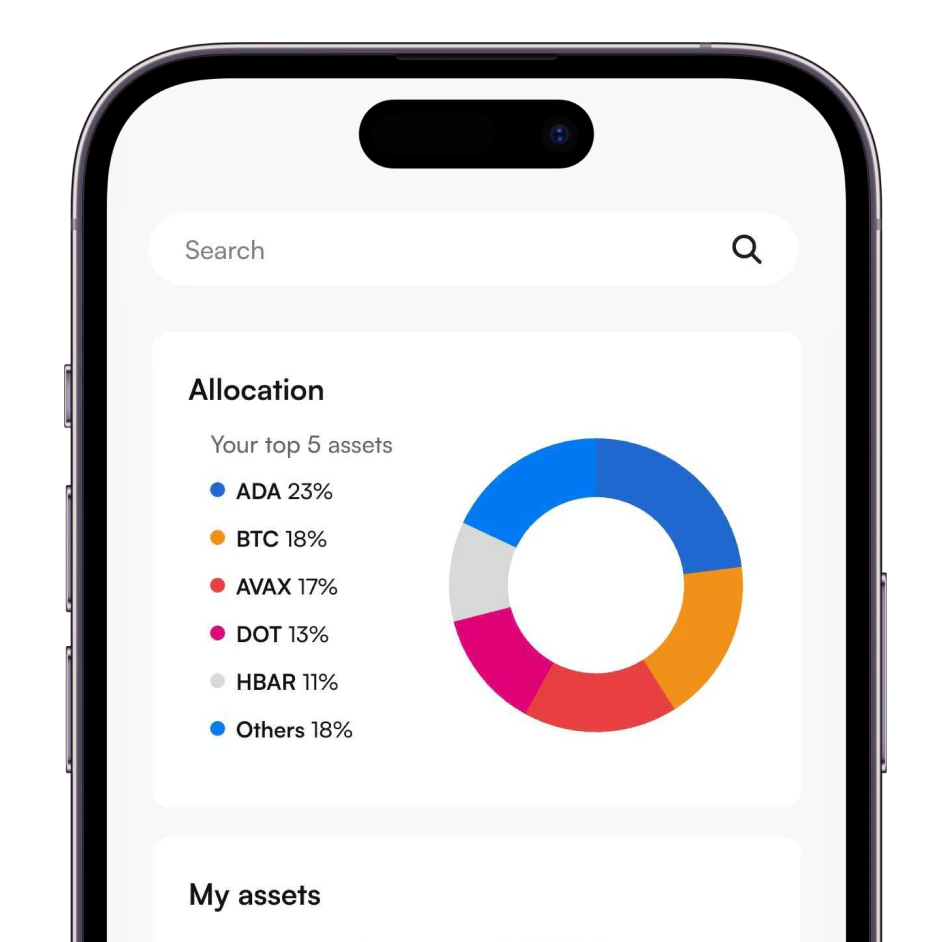
Coins
Explore the complete list of 350 coins available on Coinmerce. Click on any coin to learn more.
Bitcoin Bitcoin (BTC) is the 1st decentralized digital currency that was created in 2008. The coin uses innovative blockchain technology to store payment transactions between users. So, there is no need for a central bank or 3rd party to overlook transactions between users of Bitcoin. As a result, this makes Bitcoin is the first decentralized payment method in history that is not related to a government or central authority. You can fully control your Bitcoin wallet and transactions.
€ 73.574,50
Buy Bitcoin (BTC)
Ethereum (ETH) is a blockchain known for supporting smart contracts. Its open-source and decentralized platform allows developers to program smart contracts. This makes it possible to build and run decentralized applications, abbreviated as dApps, on Ethereum. The smart contracts can be compared to digital contracts. The execution of these smart contracts happens completely automatically when the smart contract notices that the predetermined conditions are met. This eliminates the need for an intermediary to perform certain actions. Products and services can be executed decentrally on the blockchain since the advent of smart contracts, leading to the advent of DeFi (Decentralized Finance). Ether, abbreviated as ETH, is Ethereum's cryptocurrency. ETH is a utility token used to reward validators. Anyone who wants to make a transaction on Ethereum pays their transaction fees with Ether. Thus, it is possible to stake Ether. What can you use Ethereum (ETH) for? You can use Ethereum for the development of dApps. In that case, you can use the Ethereum Virtual Machine (EVM). Within the EVM, you will find a special Software Development Kit (SDK). This kit makes it easier to develop applications with Solidity, Ethereum's programming language. You can also use Ethereum when you want to stake crypto, because the network uses Proof-of-Stake for validation of transactions. This makes Ethereum suitable for earning a passive income. But above all, use Ethereum for all its applications. Many developers have used their application on Ethereum. This has made you find games, gambling websites, lending and borrowing platforms, insurance platforms, etc. on Ethereum. When you want to use the dApps on Ethereum, you need an external Ethereum wallet, such as Metamask. You link this wallet via your browser to the application you want to use. You often need the native token of the application you want to use to deploy the dApp. You can also send Ether to other users from your wallet. You pay the transaction fees, called gas fees in this case, with Ether. Therefore, it is important that you always have Ether in your wallet when you want to conduct transactions on Ethereum. How does Ethereum work? The Ethereum network uses Proof-of-Stake as its consensus mechanism. Before that, it used Proof-of-Work. However, the Ethereum 2.0 upgrade, which began in 2021, caused a change in consensus mechanism. The high transaction costs and long processing times were the reason for this switch. Anyone can develop an application on Ethereum. This is because the blockchain is open-source. To develop applications, you pay Ether. The nodes in Ethereum's network then take care of hosting the applications. They also process all transactions performed by users.
€ 2.159,85
Buy Ethereum (ETH)

Binance Coin, perhaps better known as BNB, is the cryptocurrency issued by crypto exchange Binance in 2017. They did not do so entirely without reason, as Binance has since developed two blockchains. However, BNB was previously running on another blockchain: Ethereum. As of 2017, BNB was running on Ethereum as an ERC20 token. That is the reason BNB is currently still tradable on Ethereum's blockchain. In 2019, Binance announced that they would be launching their own blockchain, called Binance Chain. The reason for developing their own blockchain was to host their own tokens. These tokens would use the BEP2 token standard, and in a way can be compared to ERC20. Both token standards are used for fairly simple tokens. Technically, of course, these standards are different from each other. It didn't just stop with the Binance Chain, as not much later Binance launched the Binance Smart Chain (BSC). Whereas the Binance Chain can only be used to host tokens, the Binance Smart Chain can be used to host applications. In fact, as the name suggests, the blockchain provides support for smart contracts. Binance Coin, the native token of Binance Chain and Binance Smart Chain, is important for the operation of both blockchains. In fact, BNB is used to fuel the execution of smart contracts. So you could think of BNB as what Gas is to Ethereum. What can you use Binance Coin (BNB) for? You can use Binance Coin within the Binance ecosystem. In fact, the BNB token plays an important role for the operation of BC and BSC.
€ 647,83
Buy Binance Coin (BNB)
XRP is one of the largest cryptocurrencies by market capitalization and also known by its coin name Ripple. Ripple released in 2012 and has since gained popularity among both cryptocurrency enthusiasts and experts. It has been described as highly innovative, even compared to other projects. Companies and institutions such as Google and American Express have actively partnered with Ripple.
€ 1,16706
Buy XRP (XRP)
USDC is built to track the US dollar, so its price usually stays close to 1 USD. Like other crypto assets, the USDC price can still move in the short term because of supply and demand on exchanges, liquidity conditions, and broader market sentiment. On this page, you can use the EUR context to understand how USDC has behaved historically and how stablecoins can still show volatility in real markets. The key idea is that stablecoins aim for stability, but they are still traded like assets, and market conditions can affect the exact price you see. Current USDC price in euro (USDC/EUR) View the current price on the chart on this page.
€ 0,89038
Buy USDC (USDC)
Solana is a project dedicated to supporting large and high-frequency blockchain applications, another goal is to democratize financial systems. How does Solana want to achieve this? Solana is a delegated Proof of Stake protocol with a focus on scalability, without the loss of decentralization or security. Achieving scalability, decentralization and security is considered the holy grail when it comes to distributed ledger technologies. The solution Solana offers lays within its decentralized clock, called the Proof-of-History (PoH). The PoH allows each node to locally generate timestamps, eliminating the need for broadcasting these across the network. This results in a more efficient network. The project has closed partnerships with other well-known projects within the industry like Chainlink and Civic. Together with Chainlink the team will work on a high-frequency oracle designed for trading binary options.
€ 94,06
Buy Solana (SOL)
Tron is a project dedicated to the establishment of a fully decentralized internet and its infrastructure. The protocol of Tron is one of the largest blockchain systems in the world. Which offers a public infrastructure, supports high throughput and flexible scalability. In May 2018, the mainnet went online. According to official statistics, over its seven months online it has seen explosive growth in its ecosystem, with more than one million addresses being used, and more than 4,000 daily DApp users. July 2018, Tron acquired BitTorrent. BitTorrent is a communication protocol for peer-to-peer file sharing, used to send/receive electronic files over the internet.
€ 0,2951
Buy TRON (TRX)

Hyperliquid price movements usually reflect the same big forces that move the broader crypto market, supply and demand across exchanges, and changing sentiment around decentralized finance and derivatives. On top of that, HYPE can also react to ecosystem specific factors, such as how much activity happens on Hyperliquid trading venues, how developers and users adopt the platform, and how regulation and market risk appetite affect derivatives and DeFi. This page is meant to help you understand the EUR context, the token history, and the kind of volatility that can come with assets like HYPE. Current Hyperliquid price in euro (HYPE/EUR) View the current price on the chart on this page.
€ 71,03
Buy Hyperliquid (HYPE)
Dogecoin is a cryptocurrency that many people see as a joke. Not surprisingly, because the founders of Dogecoin also once set up this crypto currency as a joke. However, the market capitalization (market cap) of this cryptocurrency has increased dramatically in recent years, making Dogecoin invariably one of the largest cryptocurrencies. Jackson Palmer and Billy Markus decided to launch Dogecoin in 2013. They saw that Bitcoin was becoming more and more popular, and many people decided to create their own cryptocurrency (altcoins). Therefore, they wanted to take advantage of the hype by creating a crypto currency of their own. This crypto currency was to have a Shiba Inu as its logo. For this purpose, the picture of the well-known Shiba Inu meme was used. This is one of the reasons why Dogecoin is called a "memecoin" by many people. Shortly after its creation, Dogecoin was not used seriously. Many people thought it was only 'funny' to own Dogecoin. Therefore, the value of the coin at that time represented almost nothing. As you can read further in this article, over time Dogecoin became increasingly used for serious purposes. Dogecoin has its own blockchain, which uses Proof-of-Work (PoW). This means that the DOGE network is made up of miners. The blockchain was created from a fork of the Bitcoin blockchain. What can you use Dogecoin for? You can use Dogecoin for a variety of purposes. The crypto currency is set up as a means of payment. So you cannot use it within a specific protocol or decentralized application (dApp). Today, you can use Dogecoin on platforms like Reddit and Twitter, to tip content creators. It is also possible to buy Dogecoin on a large number of crypto exchanges, including Coinmerce. Many crypto traders use Dogecoin to speculate on price changes. Because Dogecoin is a volatile cryptocurrency, the price can sometimes change significantly. As a result, it is possible to make large gains, as well as large losses, on an investment in DOGE. In recent years, Dogecoin has been used several times to raise money for charity. When it turned out that the Jamaican bobsleigh team could not go to the Sochi Winter Olympics in 2014 due to lack of money, the Dogecoin community decided to set up a special action. With this action they wanted to raise money so that the bobsleigh team could still go to the Winter Olympics. And they succeeded, because about €50,000 worth of DOGE was raised. In 2021, Elon Musk indicated that SpaceX would send the first Dogecoin-funded rocket to the moon in 2022. At the time this was announced, 129 million DOGE coins would be needed to fund the trip. Dogecoin and Elon Musk Say Dogecoin, and you say Elon Musk. As recently as 2021, Musk called himself the "Dogefather," and regularly shared his fondness for Dogecoin on Twitter. Despite the fact that these kinds of statements don't seem to be a problem at first, they have caused a lot of controversy. Every time Musk posted a Tweet about Dogecoin, the price of this crypto currency fluctuated greatly. The direction of the fluctuation depended on the content of the Tweet. A large number of people could initially laugh at Musk's statements, although a growing group of people criticized Musk. He was said to be playing and manipulating the market, because he knew that his statements could cause significant changes in the stock price. Dogecoin: the beginning of the memecoin run Just as Bitcoin was the first cryptocurrency and was followed by altcoins, Dogecoin was the first memecoin. A memecoin is a cryptocurrency inspired by a meme. In the case of Dogecoin, that meme is a famous picture of a Shiba Inu. Creators of memecoins can use inspiration in the image or the name of the coin. After the creation of Dogecoin, more and more memecoins were created, of which the following are the most famous and notable: Shiba Inu (SHIB); Dogelon Mars (ELON); Pitbull (PIT); PolyDoge (POLYDOGE); SafeMoon (SAFEMOON); CumRocket (CUMMIES). In many cases, people are warned about such memecoins. Their value can fluctuate tremendously, as it is primarily based on the hype surrounding the coin. One Tweet can easily cause the value to double or halve. So be aware of the risks before you decide to invest in memecoins. The DOGE token There is a total inventory of 132.67 billion DOGE tokens, the number of which continues to grow continuously. At all times, 100% of the total stock is in circulation. The value of DOGE, partly due to the large number of tokens, has never risen above €1. The all-time-high (ATH) of DOGE stands at €0.56, which was achieved in May 2021. Where to buy Dogecoin (DOGE) Want to buy Dogecoin? DOGE buy in the Netherlands or Belgium at Coinmerce. Here you can pay quickly and easily with iDEAL, SEPA, creditcard, Giropay and MyBank. Before you can buy DOGE at Coinmerce, you will need an account. Fortunately, you can create one easily and quickly by clicking here.
€ 0,07076
Buy Dogecoin (DOGE)

Historically, blockchains which run smart contract couldn't support native communication with external systems. So, the vast potential of smart contracts is suppressed due to the inability to communicate off-chain Adding new functionality, the so-called oracle that provides an off-chain connection could be the solution to this problem. Although oracles are centralized services, so, adding a centralized service to a decentralized blockchain would create a single point of failure for the entire chain. The benefits of decentralization would be nullified. As a solution, Chainlink is designed as a decentralized oracle which enables off-chain communication to smart contracts.
€ 10,82
Buy Chainlink (LINK)

Cardano is the blockchain platform that houses the ADA cryptocurrency. According to the Cardano team, the digital currency represents the future of money, enabling fast, direct and guaranteed transfers through the use of cryptography. Since Cardano is also a smart contract platform, it could be compared to Ethereum. However, unlike the current form of Ethereum, Cardano claims to also be scalable by utilizing a layered architecture.
€ 0,19631
Buy Cardano (ADA)

NEAR is a decentralized development platform built on top of the NEAR Protocol, a public, sharded, developer-friendly, proof-of-stake blockchain. NEAR is like a public community-run cloud platform. That means it is a highly scalable, low-cost platform for developers to create decentralized apps on top of. While it's built on top of the NEAR Protocol blockchain, the NEAR Platform also contains a wide range of tooling from explorers to CLI tools to wallet apps to interoperability components, helping developers build much more quickly and the ecosystem to scale more widely. Whereas most other "scalable" blockchains use approaches that centralize processing on high-end hardware to provide a temporary boost in throughput, NEAR Protocol's system allows the platform's capacity to scale nearly linearly up to billions of transactions in a fully decentralized way. NEAR is being built by the NEAR Collective, a global collection of people and organizations who are collaboratively building this massive open-source project. Everyone in this Collective is focused on enabling usability improvements for both developers and their end-users so the next wave of apps can cross the chasm to a more general audience that has thus far been unable to consistently work with blockchain-based apps built on today's platforms.
€ 4,49906
Buy NEAR Protocol (NEAR)

Stellar is a public network for payments and currencies. They make it possible to trade, create and send digital representations of all forms of FIAT, for example; dollars, euros, bitcoin, etc. They designed the network in a way that all the worlds financial systems can cooperate on one network. The public owns the network; therefore, it is decentralized. Similar to Bitcoin and Ethereum, Stellar relies on blockchain technology to keep the network synchronized. But, the experience by the end-user is more convenient, comparable to cash. Stellar is more energy-efficient, cheaper and faster.
€ 0,15888
Buy Stellar (XLM)
We know Bitcoin, but what is Bitcoin Cash? Bitcoin, the first decentralized peer-to-peer network, emerged in January 2009. A transparent and decentralized network that aims to become a new financial network. But what happens when users of the network disagree about the developments after a certain period of time? Despite Bitcoin's popularity and its goal of replacing the current payment system, Bitcoin also has its limits. The blockchain of Bitcoin suffers from scalability issues and limited capacity. To solve this issue, Bitcoin Cash was created in 2017. Bitcoin Cash (BCH) is a hard fork of Bitcoin, it separated from the current blockchain. However, Bitcoin Cash also aims to fulfil Bitcoin‘s goal: to become a secure and decentralized payment system that is scalable for all its users, worldwide. How does Bitcoin Cash work? Bitcoin and Bitcoin cash are connected. In fact, until 2017, they were one blockchain. Yet, there is a significant difference between these two. Transactions are recorded in different blocks, which together form a blockchain. Minders add blocks to the blockchain to validate transactions and receive Bitcoin Cash as a reward. Exactly the same as Bitcoin. But how many transactions can the blockchain process? That depends on the block capacity. And this is where they differ from each other. Let‘s see how.
€ 247,53
Buy Bitcoin Cash (BCH)
Litecoin (LTC) is one of the most traded cryptocurrencies and was released in 2011, two years after Bitcoin. Whereas Bitcoin is often compared to gold, Litecoin is seen as silver. The technology of Litecoin is based on that of Bitcoin. And Litecoin has gone through rapid growth since early 2017.
€ 53,09
Buy Litecoin (LTC)

Uniswap (UNI) is the world's largest decentralized exchange (DEX) on the blockchain of Ethereum. Buy and sell over 100 ERC20 tokens on Uniswap using a software wallet. Uniswap's protocol is, unlike centralized exchanges, not regulated by a central party. It is a Decentralized Autonomous Organization (DAO) driven by the users of the protocol. This makes Uniswap completely transparent, decentralized and focused on its users. Do you have the governance token UNI? Use your UNI tokens and vote for a particular proposal. As holders of the governance token, you help determine the future of Uniswap. How does Uniswap work? Central exchanges use an order book. This is a list of buy- and sell orders. It shows who wants to buy or sell an asset at a given price. Uniswap on the other hand works with liquidity pools and smart contracts, both essential for Decentralized Finance (DeFi). Do you want to add liquidity yourself and receive free UNI tokens? Uniswap has several liquidity pools available.
€ 6,59001
Buy Uniswap (UNI)
Avalanche (AVAX) is an umbrella platform for launching decentralized finance (DeFi) applications, financial assets, trading and other services. It aims to be something of a global assets exchange, allowing anyone to launch or trade any form of asset and control it in a decentralized manner using smart contracts and other cutting-edge technologies. Developers at Ava Labs claim that Avalanche is the first intelligent contracts network to offer transaction finalization under a one-second standard. Avalanche launched its main net in September 2020. The platform's native token, AVAX, performs various Avalanche tasks and functions as a rewards and payment system.
€ 8,68242
Buy Avalanche (AVAX)

Sui is a layer-1 blockchain designed for high speed, low fees, and scalability. The blockchain focuses primarily on the development of next-gen Web3 apps and games. Sui is written in Move, a secure programming language originally developed by Meta for Diem (the former Facebook crypto project). How does Sui work? Sui has a unique approach to data storage and transaction processing. Unlike many other blockchains, Sui processes so-called independent transactions—such as two users sending NFTs independently of each other—in parallel rather than sequentially. This method, called parallel execution, makes the network much more efficient and drastically reduces transaction latency. Sui also uses an innovative transaction model in which simple operations, like transferring a token, do not require a traditional consensus mechanism. This enables extremely low latency and very high throughput, making the network highly suitable for user-intensive applications such as gaming or social dApps. Under the hood, Sui runs on a customised version of the Move programming language, called Sui Move. This language uses an object-based model, where each digital item is treated as a standalone object. This allows developers to manage assets in smart contracts with greater safety and precision—avoiding risks like double spending or race conditions. Sui also introduces a noteworthy feature called ZkLogin: a technology that allows users to log in with existing Web2 accounts such as Google or Apple ID, significantly lowering the barrier to entry. In short: Sui prioritises efficiency and scalability over traditional blockchain standards. The network is particularly well-suited for interactive applications such as games, NFT platforms, DeFi, and social apps—offering speed and user-friendliness as key advantages.
€ 0,89785
Buy Sui (SUI)

Canton is a cryptocurrency launched in 2024, and CC is its native token. Like other crypto assets, its price is influenced by overall market sentiment, supply and demand on exchanges, and project specific factors such as network activity and how people use the platform. On this page you can read the basics, see how Canton is described by major data sources, and explore how the CC price has moved over time in an EUR context. Crypto prices can be volatile, so it helps to understand the mechanics and the risks before you decide what to do. Canton price moves with the wider crypto market, but the day to day value of CC can also reflect changes in interest from users and builders, plus broader news about regulation and the crypto sector. Current Canton price in euro (CC/EUR) View the current price on the chart on this page.
€ 0,09103
Buy Canton (CC)

Gram (GRAM) is the native token of The Open Network, also known as TON. You can think of TON as a blockchain platform where developers build decentralized apps, and Gram as the token that helps those apps run. On TON, transactions and smart contracts are processed by a network of validators. The network uses Proof of Stake consensus, which means validators are selected based on stake rather than energy intensive mining, and changes to the blockchain require approval by the majority of validators. Gram has practical roles. It can be used to pay transaction fees, and it is also tied to validation and voting. In addition, TON supports token standards like Jettons and NFTs, so Gram can be part of the payment and participation layer for those experiences. If you are new to crypto, the simplest way to understand Gram is this: it is the token that makes TON apps and on chain actions possible.
€ 1,20017
Buy Gram (GRAM)

Hedera is a decentralized public network where developers can build applications that require secure and fair agreement on what happened. A blockchain is a shared digital ledger that records transactions or messages, and a consensus mechanism is the method the network uses to agree on those records. Hedera is often described as having a trust layer called the Hedera Consensus Service, or HCS. In plain terms, applications send messages to Hedera for consensus, and the network provides a trusted timestamp and a fair ordering of those messages. This can be useful when multiple parties need an auditable log, for example to track assets in a supply chain or to keep verifiable event records. HBAR is the native token of the Hedera network. Like other networks, it is used as part of how the platform pays for services and participates in the network ecosystem. CoinMarketCap lists Hedera as a layer 1 network and tags it for payments and enterprise solutions.
€ 0,07488
Buy Hedera (HBAR)
Bittensor (TAO) is an open-source protocol that aims to power a decentralized, blockchain based machine learning network. In simple terms, it is designed so machine learning models can be trained collaboratively, with rewards distributed to participants in TAO. A blockchain is a shared digital ledger that records ownership and activity. It uses a consensus mechanism to agree on what happened, so the network can keep a consistent history of transactions and help coordinate how new tokens are created or distributed. Bittensor is also described as providing external access to information from the network, while letting users tune how the network operates for their needs. The network is positioned around decentralized governance and open participation, so decisions are meant to be made in a community oriented way rather than by a single central operator. In this setup, TAO is the native token used inside the Bittensor ecosystem, including for rewarding participants based on the informational value they add. If you are buying TAO, you are buying the token that is used to participate in and benefit from that network design.
€ 243,89
Buy Bittensor (TAO)

Shiba Inu (SHIB) is a cryptocurrency that gained a lot of notoriety during 2021. Against all odds, the value of this meme-coin rose incredibly fast, and today this cryptocurrency is impossible to imagine the crypto space without it. Despite being a counterpart to Dogecoin, the team behind Shiba Inu has several products in the pipeline. In this article, we will tell you what Shiba Inu is and what they want to achieve in the future. At the end, we'll also explain the best way to buy SHIB tokens from Shiba Inu, and where to store them next.
€ 0,000004458
Buy Shiba Inu (SHIB)

Cronos (CRO) is a layer 1 blockchain, meaning it is a base network where transactions and smart contracts run. People use it to build and interact with tokenized applications, including exchange style and payments related use cases. Like other blockchains, Cronos stores ownership and transaction history in a digital ledger. A consensus mechanism helps the network agree on the order of transactions and makes it harder to tamper with past records. Cronos is described as EVM compatible, which means developers familiar with the Ethereum toolchain can often build on it. It is also described as using Proof of Authority consensus, with fast block times and low fees as design goals. CRO is the native token of the network. In practice, native tokens are commonly used to pay for network activity and to support the ecosystem around the chain.
€ 0,05055
Buy Cronos (CRO)
 Dutch-built, globally trusted.
The crypto app you actually want. Made with you in mind.
Over 500.000 people went before you already.
 Buy crypto in seconds.
Use your local payment method and own crypto instantly.
Buy, sell and swap over 300 cryptocurrencies.
Download the app
Trusted by 500,000+ users.