Coinmerce App
Coins
Explore the complete list of 350 coins available on Coinmerce. Click on any coin to learn more.
Bitcoin (BTC) is the 1st decentralized digital currency that was created in 2008. The coin uses innovative blockchain technology to store payment transactions between users. So, there is no need for a central bank or 3rd party to overlook transactions between users of Bitcoin. As a result, this makes Bitcoin is the 1st currency in history that is not related to a government or central authority. You can fully control your Bitcoin wallet and transactions.
€ 55.250,90
All about BTC
Ethereum (ETH) is a blockchain known for supporting smart contracts. Its open-source and decentralized platform allows developers to program smart contracts. This makes it possible to build and run decentralized applications, abbreviated as dApps, on Ethereum. The smart contracts can be compared to digital contracts. The execution of these smart contracts happens completely automatically when the smart contract notices that the predetermined conditions are met. This eliminates the need for an intermediary to perform certain actions. Products and services can be executed decentrally on the blockchain since the advent of smart contracts, leading to the advent of DeFi (Decentralized Finance). Ether, abbreviated as ETH, is Ethereum's cryptocurrency. ETH is a utility token used to reward validators. Anyone who wants to make a transaction on Ethereum pays their transaction fees with Ether. Thus, it is possible to stake Ether. What can you use Ethereum (ETH) for? You can use Ethereum for the development of dApps. In that case, you can use the Ethereum Virtual Machine (EVM). Within the EVM, you will find a special Software Development Kit (SDK). This kit makes it easier to develop applications with Solidity, Ethereum's programming language. You can also use Ethereum when you want to stake crypto, because the network uses Proof-of-Stake for validation of transactions. This makes Ethereum suitable for earning a passive income. But above all, use Ethereum for all its applications. Many developers have used their application on Ethereum. This has made you find games, gambling websites, lending and borrowing platforms, insurance platforms, etc. on Ethereum. When you want to use the dApps on Ethereum, you need an external Ethereum wallet, such as Metamask. You link this wallet via your browser to the application you want to use. You often need the native token of the application you want to use to deploy the dApp. You can also send Ether to other users from your wallet. You pay the transaction fees, called gas fees in this case, with Ether. Therefore, it is important that you always have Ether in your wallet when you want to conduct transactions on Ethereum. How does Ethereum work? The Ethereum network uses Proof-of-Stake as its consensus mechanism. Before that, it used Proof-of-Work. However, the Ethereum 2.0 upgrade, which began in 2021, caused a change in consensus mechanism. The high transaction costs and long processing times were the reason for this switch. Anyone can develop an application on Ethereum. This is because the blockchain is open-source. To develop applications, you pay Ether. The nodes in Ethereum's network then take care of hosting the applications. They also process all transactions performed by users.
€ 1.563,36
All about ETH

Binance Coin, perhaps better known as BNB, is the cryptocurrency issued by crypto exchange Binance in 2017. They did not do so entirely without reason, as Binance has since developed two blockchains. However, BNB was previously running on another blockchain: Ethereum. As of 2017, BNB was running on Ethereum as an ERC20 token. That is the reason BNB is currently still tradable on Ethereum's blockchain. In 2019, Binance announced that they would be launching their own blockchain, called Binance Chain. The reason for developing their own blockchain was to host their own tokens. These tokens would use the BEP2 token standard, and in a way can be compared to ERC20. Both token standards are used for fairly simple tokens. Technically, of course, these standards are different from each other. It didn't just stop with the Binance Chain, as not much later Binance launched the Binance Smart Chain (BSC). Whereas the Binance Chain can only be used to host tokens, the Binance Smart Chain can be used to host applications. In fact, as the name suggests, the blockchain provides support for smart contracts. Binance Coin, the native token of Binance Chain and Binance Smart Chain, is important for the operation of both blockchains. In fact, BNB is used to fuel the execution of smart contracts. So you could think of BNB as what Gas is to Ethereum. What can you use Binance Coin (BNB) for? You can use Binance Coin within the Binance ecosystem. In fact, the BNB token plays an important role for the operation of BC and BSC.
€ 534,96
All about BNB
USDC is built to track the US dollar, so its price usually stays close to 1 USD. Like other crypto assets, the USDC price can still move in the short term because of supply and demand on exchanges, liquidity conditions, and broader market sentiment. On this page, you can use the EUR context to understand how USDC has behaved historically and how stablecoins can still show volatility in real markets. The key idea is that stablecoins aim for stability, but they are still traded like assets, and market conditions can affect the exact price you see. Current USDC price in euro (USDC/EUR) View the current price on the chart on this page.
€ 0,86112
All about USDC
XRP is one of the largest cryptocurrencies by market capitalization and also known by its coin name Ripple. Ripple released in 2012 and has since gained popularity among both cryptocurrency enthusiasts and experts. It has been described as highly innovative, even compared to other projects. Companies and institutions such as Google and American Express have actively partnered with Ripple.
€ 1,03505
All about XRP
Solana is a project dedicated to supporting large and high-frequency blockchain applications, another goal is to democratize financial systems. How does Solana want to achieve this? Solana is a delegated Proof of Stake protocol with a focus on scalability, without the loss of decentralization or security. Achieving scalability, decentralization and security is considered the holy grail when it comes to distributed ledger technologies. The solution Solana offers lays within its decentralized clock, called the Proof-of-History (PoH). The PoH allows each node to locally generate timestamps, eliminating the need for broadcasting these across the network. This results in a more efficient network. The project has closed partnerships with other well-known projects within the industry like Chainlink and Civic. Together with Chainlink the team will work on a high-frequency oracle designed for trading binary options.
€ 61,70
All about SOL
Tron is a project dedicated to the establishment of a fully decentralized internet and its infrastructure. The protocol of Tron is one of the largest blockchain systems in the world. Which offers a public infrastructure, supports high throughput and flexible scalability. In May 2018, the mainnet went online. According to official statistics, over its seven months online it has seen explosive growth in its ecosystem, with more than one million addresses being used, and more than 4,000 daily DApp users. July 2018, Tron acquired BitTorrent. BitTorrent is a communication protocol for peer-to-peer file sharing, used to send/receive electronic files over the internet.
€ 0,28672
All about TRX

Hyperliquid price movements usually reflect the same big forces that move the broader crypto market, supply and demand across exchanges, and changing sentiment around decentralized finance and derivatives. On top of that, HYPE can also react to ecosystem specific factors, such as how much activity happens on Hyperliquid trading venues, how developers and users adopt the platform, and how regulation and market risk appetite affect derivatives and DeFi. This page is meant to help you understand the EUR context, the token history, and the kind of volatility that can come with assets like HYPE. Current Hyperliquid price in euro (HYPE/EUR) View the current price on the chart on this page.
€ 64,14
All about HYPE
Dogecoin is a cryptocurrency that many people see as a joke. Not surprisingly, because the founders of Dogecoin also once set up this crypto currency as a joke. However, the market capitalization (market cap) of this cryptocurrency has increased dramatically in recent years, making Dogecoin invariably one of the largest cryptocurrencies. Jackson Palmer and Billy Markus decided to launch Dogecoin in 2013. They saw that Bitcoin was becoming more and more popular, and many people decided to create their own cryptocurrency (altcoins). Therefore, they wanted to take advantage of the hype by creating a crypto currency of their own. This crypto currency was to have a Shiba Inu as its logo. For this purpose, the picture of the well-known Shiba Inu meme was used. This is one of the reasons why Dogecoin is called a "memecoin" by many people. Shortly after its creation, Dogecoin was not used seriously. Many people thought it was only 'funny' to own Dogecoin. Therefore, the value of the coin at that time represented almost nothing. As you can read further in this article, over time Dogecoin became increasingly used for serious purposes. Dogecoin has its own blockchain, which uses Proof-of-Work (PoW). This means that the DOGE network is made up of miners. The blockchain was created from a fork of the Bitcoin blockchain. What can you use Dogecoin for? You can use Dogecoin for a variety of purposes. The crypto currency is set up as a means of payment. So you cannot use it within a specific protocol or decentralized application (dApp). Today, you can use Dogecoin on platforms like Reddit and Twitter, to tip content creators. It is also possible to buy Dogecoin on a large number of crypto exchanges, including Coinmerce. Many crypto traders use Dogecoin to speculate on price changes. Because Dogecoin is a volatile cryptocurrency, the price can sometimes change significantly. As a result, it is possible to make large gains, as well as large losses, on an investment in DOGE. In recent years, Dogecoin has been used several times to raise money for charity. When it turned out that the Jamaican bobsleigh team could not go to the Sochi Winter Olympics in 2014 due to lack of money, the Dogecoin community decided to set up a special action. With this action they wanted to raise money so that the bobsleigh team could still go to the Winter Olympics. And they succeeded, because about €50,000 worth of DOGE was raised. In 2021, Elon Musk indicated that SpaceX would send the first Dogecoin-funded rocket to the moon in 2022. At the time this was announced, 129 million DOGE coins would be needed to fund the trip. Dogecoin and Elon Musk Say Dogecoin, and you say Elon Musk. As recently as 2021, Musk called himself the "Dogefather," and regularly shared his fondness for Dogecoin on Twitter. Despite the fact that these kinds of statements don't seem to be a problem at first, they have caused a lot of controversy. Every time Musk posted a Tweet about Dogecoin, the price of this crypto currency fluctuated greatly. The direction of the fluctuation depended on the content of the Tweet. A large number of people could initially laugh at Musk's statements, although a growing group of people criticized Musk. He was said to be playing and manipulating the market, because he knew that his statements could cause significant changes in the stock price. Dogecoin: the beginning of the memecoin run Just as Bitcoin was the first cryptocurrency and was followed by altcoins, Dogecoin was the first memecoin. A memecoin is a cryptocurrency inspired by a meme. In the case of Dogecoin, that meme is a famous picture of a Shiba Inu. Creators of memecoins can use inspiration in the image or the name of the coin. After the creation of Dogecoin, more and more memecoins were created, of which the following are the most famous and notable: Shiba Inu (SHIB); Dogelon Mars (ELON); Pitbull (PIT); PolyDoge (POLYDOGE); SafeMoon (SAFEMOON); CumRocket (CUMMIES). In many cases, people are warned about such memecoins. Their value can fluctuate tremendously, as it is primarily based on the hype surrounding the coin. One Tweet can easily cause the value to double or halve. So be aware of the risks before you decide to invest in memecoins. The DOGE token There is a total inventory of 132.67 billion DOGE tokens, the number of which continues to grow continuously. At all times, 100% of the total stock is in circulation. The value of DOGE, partly due to the large number of tokens, has never risen above €1. The all-time-high (ATH) of DOGE stands at €0.56, which was achieved in May 2021. Where to buy Dogecoin (DOGE) Want to buy Dogecoin? DOGE buy in the Netherlands or Belgium at Coinmerce. Here you can pay quickly and easily with iDEAL, SEPA, creditcard, Giropay and MyBank. Before you can buy DOGE at Coinmerce, you will need an account. Fortunately, you can create one easily and quickly by clicking here.
€ 0,07875
All about DOGE

Cardano is the blockchain platform that houses the ADA cryptocurrency. According to the Cardano team, the digital currency represents the future of money, enabling fast, direct and guaranteed transfers through the use of cryptography. Since Cardano is also a smart contract platform, it could be compared to Ethereum. However, unlike the current form of Ethereum, Cardano claims to also be scalable by utilizing a layered architecture.
€ 0,17295
All about ADA
Stellar is a public network for payments and currencies. They make it possible to trade, create and send digital representations of all forms of FIAT, for example; dollars, euros, bitcoin, etc. They designed the network in a way that all the worlds financial systems can cooperate on one network. The public owns the network; therefore, it is decentralized. Similar to Bitcoin and Ethereum, Stellar relies on blockchain technology to keep the network synchronized. But, the experience by the end-user is more convenient, comparable to cash. Stellar is more energy-efficient, cheaper and faster.
€ 0,18063
All about XLM

Historically, blockchains which run smart contract couldn't support native communication with external systems. So, the vast potential of smart contracts is suppressed due to the inability to communicate off-chain Adding new functionality, the so-called oracle that provides an off-chain connection could be the solution to this problem. Although oracles are centralized services, so, adding a centralized service to a decentralized blockchain would create a single point of failure for the entire chain. The benefits of decentralization would be nullified. As a solution, Chainlink is designed as a decentralized oracle which enables off-chain communication to smart contracts.
€ 7,17959
All about LINK

Canton is a cryptocurrency launched in 2024, and CC is its native token. Like other crypto assets, its price is influenced by overall market sentiment, supply and demand on exchanges, and project specific factors such as network activity and how people use the platform. On this page you can read the basics, see how Canton is described by major data sources, and explore how the CC price has moved over time in an EUR context. Crypto prices can be volatile, so it helps to understand the mechanics and the risks before you decide what to do. Canton price moves with the wider crypto market, but the day to day value of CC can also reflect changes in interest from users and builders, plus broader news about regulation and the crypto sector. Current Canton price in euro (CC/EUR) View the current price on the chart on this page.
€ 0,13356
All about CC

Toncoin (TON) is a cryptocurrency that lives on The Open Network, a general purpose blockchain. A blockchain is a shared digital ledger, meaning transaction records are stored in a way that many network participants can verify. In simple terms, Toncoin is the token people use when they interact with apps on the network. Developers can build decentralized apps and tokens on TON, and the network needs a native asset to coordinate activity and incentives. If you are new to crypto, it helps to think of Toncoin as the fuel for the TON ecosystem. When you use an app on the network, you are usually interacting with smart contracts, which are programs that run on the blockchain and follow rules automatically. Toncoin is also traded on exchanges, so its price can move with broader market sentiment as well as with changes in how the TON ecosystem is used.
€ 1,64779
All about TON
We know Bitcoin, but what is Bitcoin Cash? Bitcoin, the first decentralized peer-to-peer network, emerged in January 2009. A transparent and decentralized network that aims to become a new financial network. But what happens when users of the network disagree about the developments after a certain period of time? Despite Bitcoin's popularity and its goal of replacing the current payment system, Bitcoin also has its limits. The blockchain of Bitcoin suffers from scalability issues and limited capacity. To solve this issue, Bitcoin Cash was created in 2017. Bitcoin Cash (BCH) is a hard fork of Bitcoin, it separated from the current blockchain. However, Bitcoin Cash also aims to fulfil Bitcoin‘s goal: to become a secure and decentralized payment system that is scalable for all its users, worldwide. How does Bitcoin Cash work? Bitcoin and Bitcoin cash are connected. In fact, until 2017, they were one blockchain. Yet, there is a significant difference between these two. Transactions are recorded in different blocks, which together form a blockchain. Minders add blocks to the blockchain to validate transactions and receive Bitcoin Cash as a reward. Exactly the same as Bitcoin. But how many transactions can the blockchain process? That depends on the block capacity. And this is where they differ from each other. Let‘s see how.
€ 208,76
All about BCH

Hedera is a decentralized public network where developers can build applications that require secure and fair agreement on what happened. A blockchain is a shared digital ledger that records transactions or messages, and a consensus mechanism is the method the network uses to agree on those records. Hedera is often described as having a trust layer called the Hedera Consensus Service, or HCS. In plain terms, applications send messages to Hedera for consensus, and the network provides a trusted timestamp and a fair ordering of those messages. This can be useful when multiple parties need an auditable log, for example to track assets in a supply chain or to keep verifiable event records. HBAR is the native token of the Hedera network. Like other networks, it is used as part of how the platform pays for services and participates in the network ecosystem. CoinMarketCap lists Hedera as a layer 1 network and tags it for payments and enterprise solutions.
€ 0,07347
All about HBAR
NEAR is a decentralized development platform built on top of the NEAR Protocol, a public, sharded, developer-friendly, proof-of-stake blockchain. NEAR is like a public community-run cloud platform. That means it is a highly scalable, low-cost platform for developers to create decentralized apps on top of. While it's built on top of the NEAR Protocol blockchain, the NEAR Platform also contains a wide range of tooling from explorers to CLI tools to wallet apps to interoperability components, helping developers build much more quickly and the ecosystem to scale more widely. Whereas most other "scalable" blockchains use approaches that centralize processing on high-end hardware to provide a temporary boost in throughput, NEAR Protocol's system allows the platform's capacity to scale nearly linearly up to billions of transactions in a fully decentralized way. NEAR is being built by the NEAR Collective, a global collection of people and organizations who are collaboratively building this massive open-source project. Everyone in this Collective is focused on enabling usability improvements for both developers and their end-users so the next wave of apps can cross the chasm to a more general audience that has thus far been unable to consistently work with blockchain-based apps built on today's platforms.
€ 2,43396
All about NEAR
Litecoin (LTC) is one of the most traded cryptocurrencies and was released in 2011, two years after Bitcoin. Whereas Bitcoin is often compared to gold, Litecoin is seen as silver. The technology of Litecoin is based on that of Bitcoin. And Litecoin has gone through rapid growth since early 2017.
€ 40,66
All about LTC
Avalanche (AVAX) is an umbrella platform for launching decentralized finance (DeFi) applications, financial assets, trading and other services. It aims to be something of a global assets exchange, allowing anyone to launch or trade any form of asset and control it in a decentralized manner using smart contracts and other cutting-edge technologies. Developers at Ava Labs claim that Avalanche is the first intelligent contracts network to offer transaction finalization under a one-second standard. Avalanche launched its main net in September 2020. The platform's native token, AVAX, performs various Avalanche tasks and functions as a rewards and payment system.
€ 6,93859
All about AVAX

Sui is a layer-1 blockchain designed for high speed, low fees, and scalability. The blockchain focuses primarily on the development of next-gen Web3 apps and games. Sui is written in Move, a secure programming language originally developed by Meta for Diem (the former Facebook crypto project). How does Sui work? Sui has a unique approach to data storage and transaction processing. Unlike many other blockchains, Sui processes so-called independent transactions—such as two users sending NFTs independently of each other—in parallel rather than sequentially. This method, called parallel execution, makes the network much more efficient and drastically reduces transaction latency. Sui also uses an innovative transaction model in which simple operations, like transferring a token, do not require a traditional consensus mechanism. This enables extremely low latency and very high throughput, making the network highly suitable for user-intensive applications such as gaming or social dApps. Under the hood, Sui runs on a customised version of the Move programming language, called Sui Move. This language uses an object-based model, where each digital item is treated as a standalone object. This allows developers to manage assets in smart contracts with greater safety and precision—avoiding risks like double spending or race conditions. Sui also introduces a noteworthy feature called ZkLogin: a technology that allows users to log in with existing Web2 accounts such as Google or Apple ID, significantly lowering the barrier to entry. In short: Sui prioritises efficiency and scalability over traditional blockchain standards. The network is particularly well-suited for interactive applications such as games, NFT platforms, DeFi, and social apps—offering speed and user-friendliness as key advantages.
€ 0,71144
All about SUI

Shiba Inu (SHIB) is a cryptocurrency that gained a lot of notoriety during 2021. Against all odds, the value of this meme-coin rose incredibly fast, and today this cryptocurrency is impossible to imagine the crypto space without it. Despite being a counterpart to Dogecoin, the team behind Shiba Inu has several products in the pipeline. In this article, we will tell you what Shiba Inu is and what they want to achieve in the future. At the end, we'll also explain the best way to buy SHIB tokens from Shiba Inu, and where to store them next.
€ 0,000004476
All about SHIB

Render (RENDER) is a cryptocurrency token tied to the Render Network, a decentralized GPU compute platform. A GPU is the hardware that speeds up graphics and many types of data processing, which is useful for tasks like 3D rendering and machine learning. In plain terms, the network aims to connect node operators who want to earn by offering compute, with artists and developers who want to run intensive jobs in the cloud. Render describes this as a decentralized peer to peer network, meaning the coordination happens across many participants rather than through one central company. The RENDER token is used inside this ecosystem. Depending on the network design and the services built on top, tokens can be used to pay for network usage, align incentives between compute providers and users, and support ecosystem activities. Render operates on Ethereum, and CoinMarketCap lists it as a token launched in 2019, with the date added to major data sources as 2020 06 11.
€ 6,24741
All about RENDER

Cronos (CRO) is a layer 1 blockchain, meaning it is a base network where transactions and smart contracts run. People use it to build and interact with tokenized applications, including exchange style and payments related use cases. Like other blockchains, Cronos stores ownership and transaction history in a digital ledger. A consensus mechanism helps the network agree on the order of transactions and makes it harder to tamper with past records. Cronos is described as EVM compatible, which means developers familiar with the Ethereum toolchain can often build on it. It is also described as using Proof of Authority consensus, with fast block times and low fees as design goals. CRO is the native token of the network. In practice, native tokens are commonly used to pay for network activity and to support the ecosystem around the chain.
€ 0,05318
All about CRO
Bittensor (TAO) is an open-source protocol that aims to power a decentralized, blockchain based machine learning network. In simple terms, it is designed so machine learning models can be trained collaboratively, with rewards distributed to participants in TAO. A blockchain is a shared digital ledger that records ownership and activity. It uses a consensus mechanism to agree on what happened, so the network can keep a consistent history of transactions and help coordinate how new tokens are created or distributed. Bittensor is also described as providing external access to information from the network, while letting users tune how the network operates for their needs. The network is positioned around decentralized governance and open participation, so decisions are meant to be made in a community oriented way rather than by a single central operator. In this setup, TAO is the native token used inside the Bittensor ecosystem, including for rewarding participants based on the informational value they add. If you are buying TAO, you are buying the token that is used to participate in and benefit from that network design.
€ 194,92
All about TAO

BitTorrent is a well known name in internet file sharing, and BTTOLD is a token associated with that ecosystem. In crypto terms, a token is a digital asset that lives on an existing blockchain, rather than running its own independent chain. BTTOLD operates on the TRON network. TRON is a blockchain platform that records transactions on a shared ledger, so transfers of tokens can be verified without a traditional bank as the middle step. How the token is used can vary by ecosystem design, but with many ecosystem tokens you typically see utility tied to network participation, access, or incentives. In practice, you usually use the token by holding it in a wallet and sending it to addresses that the ecosystem supports. If you are new to crypto, the main thing to understand is that BTTOLD is not a separate internet service by itself. It is a programmable token on TRON that can represent value and permissions inside the BitTorrent related ecosystem.
€ 0,00000043
All about BTTC
Ondo (ONDO) is a cryptocurrency token that runs on the Ethereum network. Tokens like ONDO are digital assets recorded on a blockchain, where ownership and transfers are tracked by the network. In simple terms, Ondo is closely connected to an on chain governance setup called the Ondo DAO. Governance means token holders can influence decisions about how a protocol evolves. In this case, CoinGecko describes the Ondo DAO as governing Flux Finance, a lending protocol that supports tokenized securities as collateral. How the token fits in matters for everyday understanding. ONDO holders are described as having specific rights related to the Ondo DAO and its mission to broaden access to institutional grade finance. That means ONDO is not just a unit to trade, it is also a way to participate in governance linked to a DeFi lending use case. Ondo was launched in 2021 and it was added to CoinMarketCap on 2024 01 18. The token operates on Ethereum, and the project points to its foundation and documentation through ondofoundation and docs.ondo.finance.
€ 0,35809
All about ONDO

No description available
€ 0,05347
All about WLFI

No description available
€ 0,51384
All about MNT

The Polkadot project was born back in 2016. An ICO was held in October 2017, raising around $140 million in funding. The project is supported by Web3, a Swiss-based foundation funding research and development regarding the decentralized web. Polkadot can be described as a next-generation blockchain protocol which connects specialized blockchains in order to create a network of interconnected blockchains. For example, there will be a blockchain for finance, file storage, identity management and games.
€ 0,95098
All about DOT
Worldcoin is a cryptocurrency launched in 2023 that operates on the Ethereum platform. The project’s core product is World ID, a privacy preserving identity system that aims to help online services verify that a person is a real, unique human. In practice, World ID is designed to work with platforms that integrate with the protocol, so they can reduce bot and Sybil attacks. Sybil attacks happen when one person or system creates many fake identities to gain unfair influence. The WLD token is the part of the system that people can hold and use to participate in governance. It is also tied to grants for Orb verified World ID holders, subject to availability restrictions. Because WLD is traded like other cryptocurrencies, its price can move with broader market sentiment, liquidity, and demand. Project specific developments around identity tooling and governance can also affect interest over time.
€ 0,46132
All about WLD

Aster (ASTER) is a cryptocurrency token connected to a decentralized exchange platform. The platform is designed for trading perpetual contracts, which are financial contracts that track the price of an underlying asset without requiring you to hold that asset directly. In plain language, the Aster platform aims to combine two ideas. First, non custodial trading means you keep control of your crypto assets instead of handing custody to a central broker. Second, the trading experience includes features like different trading modes and order tools that are meant to work on chain. The ASTER token is used in the ecosystem for multiple purposes, including governance rights, staking rewards tied to liquidity provision, and incentives through a points program for traders and liquidity providers. Aster is described as operating across multiple networks, while CoinMarketCap lists the token on the BNB Smart Chain (BEP20) platform. If you are new, the key takeaway is that Aster is not just a token. It is also a trading platform with a specific security model and token driven incentives that affect how the system operates.
€ 0,59046
All about ASTER

Uniswap (UNI) is the world's largest decentralized exchange (DEX) on the blockchain of Ethereum. Buy and sell over 100 ERC20 tokens on Uniswap using a software wallet. Uniswap's protocol is, unlike centralized exchanges, not regulated by a central party. It is a Decentralized Autonomous Organization (DAO) driven by the users of the protocol. This makes Uniswap completely transparent, decentralized and focused on its users. Do you have the governance token UNI? Use your UNI tokens and vote for a particular proposal. As holders of the governance token, you help determine the future of Uniswap. How does Uniswap work? Central exchanges use an order book. This is a list of buy- and sell orders. It shows who wants to buy or sell an asset at a given price. Uniswap on the other hand works with liquidity pools and smart contracts, both essential for Decentralized Finance (DeFi). Do you want to add liquidity yourself and receive free UNI tokens? Uniswap has several liquidity pools available.
€ 2,41394
All about UNI
The Internet Computer (ICP) is the world's first blockchain to run at internet speed with unlimited capacity. It also represents the third major blockchain innovation, alongside Bitcoin and Ethereum. The Internet Computer is a blockchain computer that scales smart contract calculations and data, executes them at web speed, processes and stores data efficiently, and provides powerful software frameworks to developers. By making this possible, the Internet Computer offers the opportunity to completely rethink software - offering a revolutionary new way to build tokenized Internet services, pan-industry platforms, decentralized financial systems, and even traditional business systems and Web sites. Founded in October 2016 by Dominic Williams, the project attracted significant interest from the crypto community. DFINITY raised $121 million from backers such as Andreessen Horowitz, Polychain Capital, SV Angel, Aspect Ventures, Electric Capital, ZeroEx, Scalar Capital, and Multicoin Capital, as well as several notable early Ethereum backers. In a final step toward decentralization, on May 10, 2021, DFINITY launched the Internet Computer into the public domain. This important milestone means that the Internet now functions as a decentralized global computer - marked by the release of all of the Internet Computer's source code into the public domain, as well as ICP utility token that allows tens of thousands of community members to control the Internet Computer network.
€ 2,67058
All about ICP
Sky (SKY) is a token that is used inside Sky Protocol, which runs on Ethereum. In plain language, a blockchain is a shared digital ledger that records transactions, and smart contracts are programs on that ledger that execute rules automatically. Sky Protocol is built around a stablecoin called USDS. USDS is designed to stay at one US dollar, and the protocol is intended to be decentralized, meaning there is no single person or company controlling user funds. SKY has two main roles. First, it gives holders voting power, so the community can decide on important system changes. Second, SKY can be staked in the Staking Engine, which means you lock tokens to help the system run, and you may receive rewards. Sky Protocol also uses SkyLink to connect funds across different blockchains for faster and cheaper transactions. If you are looking at SKY as an investment, it helps to understand that its value is tied to how the protocol is used, how governance decisions are made, and how staking and borrowing features attract users.
€ 0,05838
All about SKY

No description available
€ 15,57
All about DEXE

Pepe (PEPE) is a cryptocurrency launched in 2023 and it runs on the Ethereum platform. It is commonly described as a community based meme token built around the Pepe the frog meme. In simple terms, a blockchain is a shared digital ledger that records who owns which tokens. The network uses a consensus mechanism to agree on the order of transactions and to prevent double spending. On Ethereum, this means token transfers and smart contract actions are validated by the network, so you can move PEPE without a bank or other central authority keeping the records for you. What makes Pepe stand out is its focus on meme culture and community. The token is mainly used for participation in that culture, and it is also used by traders and speculators who want exposure to meme driven sentiment. CoinMarketCap lists Pepe under the Ethereum platform and tags it with memes and ecosystem related labels. If you are new to crypto, think of PEPE as a token that lives on a blockchain, where the community and attention around the meme drive much of the activity.
€ 0,000002692
All about PEPE
Ethereum Classic (ETC) is a cryptocurrency that powers a blockchain network. A blockchain is a shared digital ledger that records transactions and smart contract activity so many computers can agree on what happened. Ethereum Classic is part of the Ethereum family, but it keeps its own chain and community. People use ETC to pay for network activity and to transfer value, and developers can deploy smart contracts that run on the network. Security is maintained through proof of work. In proof of work, computers compete to add new blocks, and the network makes it costly to rewrite history. In practice, ETC is the native token of the Ethereum Classic network. It is used to pay for transactions and to participate in the network ecosystem that builds on that chain.
€ 6,66329
All about ETC

Aave (AAVE) is a DeFi (Decentralized Finance) protocol which offers the possibility to lend and borrow crypto. Such a protocol is often characterized by publicly available smart contracts built on the Ethereum network. There are currently 20 cryptocurrencies available on the Aave-platform, each with their own liquidity pool. These liquidity pools are fundamental to the platform. You could view it as a piggy bank, where lenders deposit their crypto into, for borrowers to take them out on a loan. Borrowers have to offer a collateral to ensure the lender getting back his crypto. This collateral is also offered in the form of cryptocurrencies. As is common with loans, the borrower pays interest to the lender. With Aave, the borrower can choose between a stable interest rate or a variable interest rate, where the stable interest rate is usually higher. It‘s also possible to get a flash loan with Aave. A loan with no need for collateral where the loaned amount with an extra of 0.09% interest gets repaid within the same Ethereum block. On average, an Ethereum block takes 13 seconds. If it doesn‘t get repaid, the whole transaction gets reversed, so Aave and the lenders aren‘t exposed to the risk of default. An example of a use case for flash loans is when arbitrage opportunities arise. In such a case, there is a price difference on two different exchanges for the same cryptocurrency. A flash loan can be used to take advantage of this.
€ 64,19
All about AAVE

Ethena (ENA) is a cryptocurrency token that operates on the Ethereum platform. In simple terms, a token is a digital unit that can represent rights or utility inside a blockchain application. Ethereum is a blockchain, which is a shared ledger that records transactions. The network uses a consensus mechanism to agree on the order of transactions, so the history is hard to change. This matters because it is the base layer where token ownership and smart contract activity are recorded. Ethena is positioned in decentralized finance, which typically means people use smart contracts to access financial features like lending, trading, or yield related strategies without a traditional bank in the middle. ENA is the token that connects users to the Ethena ecosystem, where it can be used for functions defined by the project. If you are new, the key idea is this: you are not just buying a price chart. You are buying a token that may be used inside DeFi applications running on Ethereum, so you should also understand how those applications work and what risks come with smart contracts.
€ 0,09741
All about ENA

Polygon (prev. MATIC) is a cryptocurrency token with the ticker POL. It is part of the Ethereum ecosystem and is commonly associated with layer 2 scaling, which means it aims to help Ethereum handle more activity with less friction. A blockchain is a shared digital ledger. It records transactions in blocks and uses a consensus mechanism to agree on the order of records. In practice, this is how ownership and transfers are verified without a single bank or company keeping the database. Polygon is used by developers and users to run applications and smart contracts, and the POL token is involved in the ecosystem for network related activity and governance. If you are buying POL, think of it as the token that connects to how the ecosystem operates, rather than as a payment card for everyday purchases. For this page, you can use the sections below to understand what Polygon is, how POL fits in, and what the main risks and uncertainties are when you hold or use a crypto token.
€ 0,0806
All about POL

KuCoin Token, symbol KCS, is a cryptocurrency token that runs on the Ethereum blockchain. In simple terms, a blockchain is a shared digital ledger that records transactions, and Ethereum uses a consensus mechanism to keep those records consistent across many computers. KCS is often discussed as an exchange based token. That means its value and usefulness are closely linked to the exchange ecosystem where it is used, rather than to a separate independent app that everyone can build on. On Ethereum, token ownership is tracked through wallet addresses. When you hold KCS, you are holding a balance in that ledger, and the exchange ecosystem can define how token holders get access to certain benefits. This page focuses on what drives understanding of KCS, how the token fits into the Ethereum ecosystem, and what to consider when you look at its risks and potential future.
€ 6,24324
All about KCS
Algorand is a blockchain that has gained a lot of notoriety since its launch. Algorand's cryptocurrency, ALGO, is therefore very popular among crypto traders. The value of the token has therefore already gone up since its launch, as has the number of applications running on Algorand's blockchain. Below you can read what Algorand is, how it works and where you can buy and store Algorand (ALGO). What does Algorand do? Algorand is a public blockchain that supports smart contracts. This means that anyone can join the blockchain's network, or use what the network has to offer. The network of a public blockchain needs to be scalable enough to avoid problems that many other blockchains run into. Thus, because Algorand offers support for smart contracts, developers can build their own decentralized application (dApp) on Algorand's blockchain. It is also possible for developers to develop their own token on the blockchain. For this, developers and users can pay with ALGO tokens. The blockchain was only launched in 2019, but since then it already has a fairly large number of users. This is because the team behind Algorand has optimized the blockchain to process transactions quickly. A transaction made on Algorand can be processed at about the same speed as a transaction made with Mastercard or Visa. Because of this high speed for transaction processing, Algorand can be seen as a serious competitor to Ethereum. After all, both blockchains are suitable for the development of applications and tokens. However, Algorand seems to be a lot faster and more scalable, but has not yet proven itself on a large scale, as Ethereum has.
€ 0,09176
All about ALGO

Cosmos is also called the 'internet of blockchains', and that is not without reason. With Cosmos, blockchains are connected to each other, which makes interaction between different blockchains possible. With Cosmos developers can also quickly and easily set up their own blockchain. The basis is provided by Cosmos, and they only have to deal with the details. This leaves more time for the development of decentralized applications (dApps) that run on the blockchain. What is Cosmos (ATOM)? Cosmos is also known as the "internet of blockchains," and for good reason. This is because Cosmos connects blockchains together, allowing interaction between different blockchains. In essence, blockchains cannot interact with each other. This is because each blockchain uses its own rules and protocols. These differences ensure that data cannot be transferred. The problem that arises here is also known as the interoperability problem. Cosmos is a decentralized network that ensures that individual blockchains can be linked together. This collaboration can take place while the blockchains continue to run within their own ecosystem.
€ 1,59858
All about ATOM

Terra Classic (LUNC) is a cryptocurrency launched in 2019. It is commonly described as a decentralized financial payment network that tries to rebuild parts of the traditional payment stack using blockchain technology. In this ecosystem, LUNC is tied to how the network aims to support its stablecoin system. CoinGecko describes three core functions: it helps mine Terra transactions through staking, it helps ensure price stability of Terra stablecoins, and it provides incentives for the platform’s blockchain validators. Like many cryptocurrencies, Terra Classic relies on a blockchain and a consensus mechanism to record ownership and confirm transfers. A blockchain is a shared digital ledger, and the consensus mechanism helps secure transaction history and coordinate the network without a central bank or government. In practice, people use LUNC to participate in the ecosystem, including activities connected to staking and validator incentives, and to access decentralized finance applications built on the Terra Classic platform.
€ 0,000123676
All about LUNC

Morpho is a DeFi lending and borrowing platform built on Ethereum. In DeFi, “lending” means you deposit assets into a system that other people can borrow, and “borrowing” means you post collateral and receive the borrowed asset based on the rules of the protocol. On Morpho, lenders can use Morpho Vaults, which are noncustodial lending vaults designed to optimize yields for depositors. Borrowers can take out loans directly from Morpho Markets. Developers can also create markets and vaults using Morpho’s permissionless infrastructure. The MORPHO token is part of the ecosystem around this lending and borrowing activity. Like many crypto assets, the MORPHO price can move with the wider crypto market, plus project specific factors such as usage of lending markets, developer activity, and broader DeFi sentiment. This page gives you EUR context, a quick history, and a plain language view of volatility.
€ 1,60411
All about MORPHO

Kaspa (KAS) is a cryptocurrency launched in 2021. It runs on its own blockchain, which is a shared digital ledger maintained by a network of computers. Kaspa uses proof of work, meaning computers compete to add new blocks by doing computational work. Kaspa also uses a BlockDAG design with a protocol called GHOSTDAG, which helps the network handle multiple blocks that can appear around the same time. In practice, people use Kaspa like other cryptocurrencies: they can hold KAS, transfer it to others, and use it inside the Kaspa ecosystem. KAS is also generated through mining, which is how new coins come into circulation on the network. If you are comparing cryptocurrencies, Kaspa is often grouped with Layer 1 networks and proof of work systems, and it is tagged as mineable and store of value.
€ 0,02755
All about KAS

How easy would it be if you could use Bitcoin with a dApp running on Ethereum's blockchain? Right now, you'll have to sell your Bitcoin for Ether first, and then you be able to use it with an application on Ethereum. If it's up to Quant Network, this won't have to be the case any time soon and you can just spend assets from one blockchain on another. We're happy to explain what Quant Network is, and where you can buy QNT tokens.
€ 61,61
All about QNT
Filecoin (FIL) describes itself as a peer-to-peer network which facilitates file storage. Economic incentives are in place to ensure that files are stored securely and reliably. Filecoin users who wish to store their files on so-called storage miners pay them in Filecoin (FIL). Storage miners can be described as computers who have offered their internal hard drive storage capacity to the network. When a user rents the storage, the miner will have to prove that his or her files are correctly stored. A single actor does not decide the price of storage; instead, the protocol relies on open markets which will eventually determine a cost.
€ 0,80193
All about FIL
Nano (XNO), formerly known as Raiblocks, is a cryptocurrency and an open-source digital payment system designed to enable fast and scalable transactions. Nano utilizes its proprietary technology called the Block Lattice protocol. Unlike traditional blockchain structures that record all transactions in a single chain, Nano uses individual blockchains for each user, referred to as accounts. Each account has its own blockchain, contributing to the scalability and speed of the network. One of the key features of Nano is the ability to perform transactions without any fees. This is achieved through an asynchronous architecture and the use of an innovative variant of the Delegated Proof of Stake (PoS) mechanism called Open Representative Voting. This allows transactions to be processed nearly instantaneously without incurring any charges. In general, Nano aims to provide a fast, scalable, and feeless solution for transactions, making it suitable for various applications such as peer-to-peer payments and microtransactions. How can I use Nano? You can use Nano to make payments with XNO without paying additional transaction fees or relying on a central authority. The system is particularly well-suited for microtransactions because they can be processed quickly and without any additional costs. In contrast, systems like Bitcoin often require significant fees and take longer to process transactions. If you want to perform and receive peer-to-peer payments, Nano offers an excellent solution. It can also be used for global payments and donations, and its speed makes it suitable for in-store purchases. What are the advantages of Nano? Nano has a strong advantage in scalability as it does not require mining or staking, allowing transactions on the network to be more efficient without the energy-intensive processes associated with traditional blockchain networks. This also makes the network very fast, with transactions being fully executed within a second. This is partly why the project changed its name, to indicate that processes can be completed within a "nanosecond." In other projects, it may take several seconds to minutes for a transaction to be executed. Nano operates on an ORV system, which stands for Open Representative Voting. This means that users can vote for a representative for their account, who acts as a validator to approve transactions. This system makes Nano highly energy-efficient, and there are no transaction fees as validators do not receive compensation for their work, making it a perfect solution for microtransactions. Who founded Nano? Nano was founded by Colin LeMahieu, a software developer and engineer with extensive experience, having worked in prominent companies such as Dell, AMD, and Qualcomm. LeMahieu has diverse interests, ranging from space technology to physics and sustainability, and is a well-known name in the world of digital cryptocurrencies. He started working on Nano in 2014 and is still the Director of the Nano Foundation. Meanwhile, he has assembled a team and continues to work enthusiastically on the project. Nano vs. other cryptocurrencies Nano is built on a DAG (Directed Acyclic Graph), which is a data structure that consists of a collection of nodes and directed edges between those nodes. The main feature of a DAG is that it does not contain cycles, meaning there is no sequence of directed edges that lead back to the same node. In a DAG, these nodes can contain different types of information, such as transactions or events. It is seen as an alternative to blockchain due to its lack of block or chain structure. Instead, transactions form an acyclic graph, with each new transaction requiring validation of previous transactions. This structure provides high scalability and transaction speed. Can I make money with Nano? It is possible to make money with Nano by selling it for a higher price than you purchased it for. However, it's essential to keep in mind that cryptocurrencies are volatile, and you may also incur losses. Always trade responsibly.
€ 4,36781
All about XNO

Aptos (APT) is a layer 1 blockchain that uses the Proof-of-Stake (PoS) consensus mechanism. This puts Aptos in a lineup between other blockchains like Bitcoin, Ethereum and Cardano; these too are layer 1 blockchains. But why do we really need another layer 1 blockchain? Aptos' blockchain focuses on Web 3.0. This is a technical development that we are currently finding ourselves in. Web 3.0 is also called the "new Internet" and is the name for all economic services, products and applications that are built on the blockchain. These include DeFi, NFTs, GameFi, Play-to-Earn (P2E) games and crypto. Decentralization is central to Web 3.0. Aptos wants to be a blockchain that makes Web 3 adoption easier. It does so by creating an ecosystem that has solved the main problems of other blockchains. These include problems such as the blockchain trilemma (scalability, security and decentralization), as well as usability. On Oct. 17, 2022, the mainnet of Aptos was launched. Developers can program their own smart contracts using the Move programming language. This programming language ensures that smart contracts can be executed securely and quickly. The network can perform a large number of transactions which leads to fast transaction processing. This high transaction throughput is possible because transactions are processed in parallel. Also, the developers have used various techniques that optimize performance and decentralization. The network also tracks the reputation of validators. They are chosen to process transactions partly based on their reputation. All of this makes Aptos, they say, much faster, more secure and more scalable than its competitors. What can you use Aptos (APT) for? Aptos supports the development of smart contracts. Developers can therefore build their own decentralized application on Aptos' blockchain. They are also able to develop and run cryptocurrencies on Aptos. This makes Aptos a blockchain that can be used by developers, but can also be important for end users. These end users, according to Aptos, would be able to use applications that can be used securely, quickly and at low cost. Many competitors do not offer this capability because they suffer from the blockchain trilemma. This trilemma means that a blockchain can only meet two of its three main characteristics (secure, decentralized and scalable), whereas ideally it should meet all three. Who are the founders of Aptos? Mo Shaikh is the CEO and co-founder of Aptos. This is not the first crypto project Shaikh has worked on, as in the past he was Director of Strategy at ConsenSys, a large blockchain company. Currently, Shaikh is a consultant and advisor at several other companies. Avery Ching is the CTO and other co-founder who has been active as a software developer for more than 10 years. Within Aptos, Ching provides technical development for Aptos as an executive along with a large team consisting of several software developers. In the past, Ching was vice president at Apache Giraph. Who are Aptos' competitors? Of course, Aptos is not the only layer 1 blockchain that supports smart contracts. As a result, Aptos has a large number of competitors. Aptos' competitors include: Layer 1 blockchains such as Ethereum (ETH), Binance Smart Chain (BSC), Solana (SOL), Cardano (ADA) and Avalanche (AVAX). Layer 2 scaling solutions such as Polygon (MATIC), Optimism (OP) and Arbitrum. Layer 1 programs such as Moonbeam (GLMR) and Astar (ASTR). The APT coin APT is the cryptocurrency of Aptos. You can think of APT as the fuel of Aptos. In fact, without the APT coin, the blockchain would not be able to run. When users want to make a transaction on Aptos, they pay the transaction fee with the APT coin. Validator nodes can discontinue APT when they want to contribute to transaction processing and block creation. Staking APT allows you to earn a passive income from Aptos. Tokenomics of Aptos There is a total inventory of 1,000,000,000 APT coins, according to Aptos. Of these 1 billion APT coins, 130 million tokens were in circulation at the launch of the mainnet (Oct. 17, 2022). The number of tokens in circulation will continue to increase in the coming years. APT tokens are distributed in the following way: 51.02% is for the community; 19% is for the team, consultants and private investors; 16.5% is for the foundation; 13.48% is for investors. Where to buy Aptos (APT)? Do you want to buy Aptos (APT)? At Coinmerce you can buy Aptos with iDEAL and SEPA. In the Netherlands and Belgium you buy APT coins of course at Coinmerce. Here you buy Aptos. On this page you can indicate in the buy window how many APT crypto tokens you want to buy. It is also possible to enter a euro amount, after which Coinmerce calculates how many APT coins you will get for this amount. Aptos you can buy with a normal market order, stop limit order or repeating order. Therefore, Coinmerce is an ideal platform for both the novice and advanced crypto trader looking to buy Aptos. Do you want to buy APT but don't have an account with Coinmerce yet? Then you can create an account here. After you create an account you can trade up to more than 120 different cryptocurrencies on Coinmerce's platform. In which crypto wallet to store Aptos (APT)? You store Aptos (APT) easily and securely in your personal Coinmerce wallet. After you buy Aptos, you'll find the APT tokens right in your wallet. Coinmerce keeps most of its cryptocurrencies in cold storage. Want to make your account extra secure? Then enable two-factor authentication (2FA). It is also possible to store Aptos in an external wallet after you buy the coins from Coinmerce. For example, consider an external hardware wallet such as Trezor or Ledger. To do this, you must first verify the wallet address with Coinmerce. You can do this within your account.
€ 0,69907
All about APT

Jupiter (JUP) is tied to a decentralized exchange platform that runs on the Solana blockchain. In practice, that means you interact with Jupiter through on chain trading tools, where your swap is routed through available liquidity sources rather than a single centralized order book. Like many crypto assets, the JUP price moves with broader market supply and demand, and with project specific factors such as how much people use the Jupiter exchange features, how liquidity changes over time, and how the wider DeFi market feels. This page is designed to help you interpret the numbers in an EUR context, including historical snapshots and the kind of volatility that can come with new and fast moving tokens. Current Jupiter price in euro (JUP/EUR) View the current price on the chart on this page.
€ 0,1724
All about JUP

Injective Protocol (INJ) want to create a genuinely free and decentralized financial infrastructure for everyone. Its mission is to build a more open and inclusive financial platform through decentralization.
€ 5,60926
All about INJ

XDC Network (XDC) is a hybrid blockchain that has a private and public part. The fact that XDC Network has two sections provides a solution for financial and business institutions that want to use blockchain technology. Therefore, the goal of XDC Network is to solve problems within international trade and finance. The network uses the XDPoS consensus mechanism. This is a Delegated-Proof-of-Stake mechanism within which Masternodes ensure the security of the network and the processing of transactions. This mechanism ensures that transactions are processed almost instantly and provides better interoperability. Interoperability is the collaboration between different blockchain components that do not normally go together. There will be about 150 Masternodes active within XDC's network by 2022. It is possible to set up a Masternode yourself by staking XDC tokens. This is not exactly cheap, as you will be staking a minimum of 10 million XDC tokens to run a Masternode. The low number of Masternodes ensures that transactions are validated incredibly quickly. Users wait no longer than 2 seconds for their transaction to be processed. The network can process about 2000 transactions per second (TPS). What can you use XDC Network for? A large number of companies could make use of XDC Network. Because XDC Network is a hybrid blockchain, there are a wide range of applications to consider. The blockchain supports smart contracts, which means that any developer can develop an application or protocol on the blockchain. Smart contracts are digital contracts that can be programmed. It is possible to decentralize centralized applications by developing an application within the smart contract. When you are not a developer or a company, you can use the applications that run on XDC Network. These are generally specific applications designed to replace current central systems and products. For example, TradeFinex's trading platform runs on this blockchain. This platform makes it possible for anyone to send money, completely peer-to-peer. So people no longer need a bank to send money. DCB Bank has chosen to move their insurance system to XDC Network's blockchain. For them, this hybrid blockchain is the ideal solution to problems they encounter on centralized systems. XDC Network is also used by Land Registry for land registry management and administration. How does XDC Network work? XDC Network's blockchain is EVM compatible, uses the ISO20022 message standard, and deploys sharding to process transactions quickly.
€ 0,02662
All about XDC

Pump.fun is a cryptocurrency (PUMP) that operates on the Solana platform. In practice, Pump.fun is best understood as a place where community members create and trade tokens, often in the meme and social style. A blockchain is a shared digital ledger that records who owns what. Solana uses a consensus mechanism to agree on transaction history across many computers, so transfers and token related actions can be verified without one central database. The PUMP token is the native token associated with the Pump.fun ecosystem. Tokens like PUMP are commonly used to participate in the platform’s community and activities, and they can also be traded on crypto markets like other cryptocurrencies. If you are new, the key thing to remember is that meme and social tokens can move quickly because they are driven by attention, community behavior, and market liquidity, not by cash flows like a traditional company.
€ 0,00152477
All about PUMP

Flare (FLR) is an EVM (Ethereum Virtual Machine) based interoperative blockchain that enables using smart contracts on the XRP network. The native currency used for this is the Flare token (FLR). Flare has been developed to form an interoperative blockchain, which means that it‘s now possible for multiple blockchains to communicate with each other. Where previously you were not able to use Ethereum smart contracts on the XRP network, this is now possible thanks to the Flare network. How does Flare work? The Flare network uses two protocols: the State Connector and the Flare Time Series Oracle (FTSO). The State Connector protocol ensures that data from outside the blockchain can be used securely within the chain, such as general information or information about a transaction. The Flare Time Series Oracle is a smart contract that runs on the Flare network and through continuous calculations forms a source of reliable off-chain data for use on the network. This is done in a decentralized and secure manner, so there is no party that has the upper hand. The Flare network uses their native token FLR. This gives you several options on the network. You support the network by decentralizing the FTSO, securing the network, participating in the governance model and paying transaction costs. This also prevents the network from being overloaded by numerous requests. If these transactions were completely free, there would probably be a lot of useless transactions to spam the network (also known as DDoS attack). The introduction of the Flare token (FLR) was announced in 2020, then known by the name Spark token. Because Flare would enable the connection to the XRP network from the Ethereum blockchain, each XRP holder would receive a share of FLR tokens that was 1:1 with the number of XRP tokens. The first airdrop occurred in January 2023, when 15% of the Flare to be paid out was airdropped. In total there are 100 billion FLR out there.
€ 0,00618674
All about FLR

Arbitrum is a scaling solution built for Ethereum. In practice, it is a layer 2 network, which means it is designed to process many transactions outside the main Ethereum chain, then settle back in a way that keeps the connection to Ethereum. A common way to think about layer 2 is traffic management. Instead of every transaction going through the busiest part of Ethereum, Arbitrum aims to bundle and process activity more efficiently, so apps can feel faster and often cost less to use. Arbitrum is described as an optimistic rollup. That means transactions are grouped together, and the system assumes they are valid unless someone challenges them. If there is a challenge, the network uses a dispute process to decide what is correct. ARB is the native token for the Arbitrum ecosystem. Tokens like ARB are commonly used for governance and ecosystem coordination, so holders can participate in how the network and related decisions move forward.
€ 0,08029
All about ARB

Fetch.ai (FET) is a decentralized, open-source blockchain that focuses on providing a platform for the development and deployment of decentralized autonomous agents, or "smart digital entities". These can be used for a wide range of tasks, such as data analysis, prediction and automation. The platform uses a unique consensus mechanism called "Adaptive Proof of Stake" which ensures fast and efficient transactions while also providing a high level of security. Fetch.ai also has a built-in cryptocurrency called FET that is used to reward network participants and pay for use of the platform's resources. Fetch.ai price The price of a cryptocurrency can be influenced by a variety of factors, including market demand, trading volume and general market conditions. It can be useful to track the price of FET over time and compare it with other cryptocurrencies to get an idea of its performance. In addition, you can consult cryptocurrency trading platforms such as Coinmerce to see the current price of FET against other currencies such as USD, EUR, BTC and ETH.
€ 0,2205
All about FET

Nexo is a platform where you can find loans. It is possible to use this platform as a lender or borrower. When you want to borrow crypto on Nexo's platform, you will need to put up collateral. This is only possible in the form of cryptocurrencies such as Ripple, Bitcoin, or Ethereum. In this way, you demonstrate that you are creditworthy and can repay the borrowed amount. Because the blockchain is a peer-to-peer technology, there are no central authorities that can check the creditworthiness of users. Therefore, it is necessary to put up collateral. This is how you demonstrate your reliability. Nexo has also issued its own credit card, which you can use to pay in stores. Before you can use this payment card, you will need to put in crypto as collateral. This project runs on the blockchain of Ethereum. This makes you partly dependent on the transaction fees and processing times associated with this platform. What can you use Nexo (NEXO) for? Nexo is a crypto project that is primarily used as a platform for fiat loans. In addition, Nexo has issued a number of other interesting products.
€ 0,68311
All about NEXO

VeChain is a blockchain platform designed to enhance supply chain management and business processes. The goal is to streamline these processes for complex supply chains through the use of distributed ledger technology, in this case blockchain. The VeChain platform has two tokens: VeChain Token (VET) and VeChainThor Energy (VTHO). The first is used to transfer value across VeChain‘s network, and the last is used as gas to process transactions. The white paper reads as follows, VeChain is “to build a trust-free and distributed business ecosystem platform to enable transparent information flow, efficient collaboration, and high-speed value transfers”. Data from businesses processes in a supply chain is often compartmentalized in silos. The challenge is to create a 360-degree view of the data for all the stakeholders to optimize the flow of information.
€ 0,00482187
All about VET

Virtuals Protocol is a platform for AI agents that are used in gaming, entertainment, and virtual environments. In plain terms, an AI agent is software that can take an input, generate a response, and often keep some memory of what happened before. The ecosystem uses blockchain technology to record ownership and transactions on a distributed ledger. A blockchain is a shared database that keeps a history of changes, and a consensus mechanism is used to agree on that history. In crypto, that is how transfers of tokens and other on chain actions can be verified without a single central database. VIRTUAL is the native token in the Virtuals Protocol ecosystem. Users can pay fees in VIRTUAL when they interact with agents, and the protocol revenue can be used for periodic buybacks and burns, which reduces the token supply over time. CoinMarketCap lists Virtuals Protocol as operating on the Ethereum platform, and it is also described by ecosystem data as expanding across other networks. If you are new, think of it as a token driven marketplace for AI agent experiences, not just a standalone coin.
€ 0,62743
All about VIRTUAL
No description available
€ 2,2396
All about DYDX
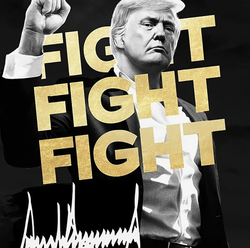
OFFICIAL TRUMP (TRUMP) is a cryptocurrency built on the Solana blockchain. It is part of the meme and politics themed category, and it is designed around a community ecosystem rather than a traditional business product. In practical terms, you hold TRUMP in a wallet, and you can use it as the in game currency for a licensed Trump Billionaires Club mobile and web game. The token is also described as a requirement for attending certain exclusive real world gatherings, such as VIP parties. How it works at a high level: a blockchain is a shared digital ledger that records ownership and transfers. Solana uses a consensus mechanism to help the network agree on which transactions are valid, so token transfers and in game actions can be processed quickly and with low transaction costs. The token supply is programmatically released over time to help reduce sudden supply shocks, and the ecosystem uses liquidity support mechanisms to help keep trading smoother. On the market, OFFICIAL TRUMP is traded as a meme token with Solana ecosystem and political meme tags.
€ 1,7052
All about TRUMP
IOTA is a distributed ledger for the Internet of Things (IoT), built to help devices exchange value and data as part of everyday technology. Instead of focusing on large, fee heavy transfers, it is designed around microtransactions and secure data transfer. A distributed ledger is a shared database that runs across many computers. It uses a consensus mechanism to agree on what happened, so ownership and records do not rely on one central party. IOTA is based on a structure called the Tangle, which uses a directed acyclic graph (DAG) approach. In the Tangle, there are no blocks in the traditional sense, and transactions validate two previous transactions through a small proof of work. The native token, IOTA, is used within the network ecosystem. Depending on the network design and application, it can be used for paying for network related actions, and it is also the token that holders typically track on exchanges.
€ 0,14461
All about IOTA

No description available
€ 0,00610124
All about PENGU

Bonk (BONK) is a dog themed memecoin that runs on the Solana platform. It launched on Christmas Day in 2022, and it was created to revitalize the Solana community after the FTX collapse. In plain terms, a blockchain is a shared digital ledger that records who owns which tokens. Transactions are grouped into blocks, and the network uses a consensus mechanism to agree on the order of those blocks and to secure the history. Bonk is a token on Solana, so the token ownership records and transfers are handled by the Solana network. What makes Bonk stand out is its community focus and its ecosystem integration. The project describes fair launch mechanics and a grassroots approach, and it also uses an active deflationary strategy through token burns. BONK can be used in ecosystem products such as a memecoin launchpad, a decentralized exchange, and a Telegram bot that includes burn mechanics. As with most memecoins, BONK is highly speculative. Its value is closely tied to community sentiment and meme momentum, so it can move sharply even without major technical changes.
€ 0,000004346
All about BONK

Litentry (LIT) is a decentralized identity aggregator that connects and manages user identities across different blockchains. The platform enables users to have control over their identities and provides decentralized applications (dApps) real-time access to decentralized identities (DIDs) of identity owners across different blockchains. Litentry is built on the Polkadot network and aims to become a Parachain of this network. Who founded Litentry? Litentry was founded by a team of developers including Hanwen Chen, Fei Liu, and Han Zhao. The exact number of team members and their backgrounds are not fully known. How does Litentry work? Litentry utilizes a decentralized identity aggregator to collect and manage user identities across different blockchains. The platform indexes and combines fragmented identities to create a detailed picture of the identity, in accordance with the DID standards of the World Wide Web Consortium (W3C). This allows users to manage and verify their identities without the need for account registration and new registration methods for developers. What sets Litentry apart? What sets Litentry apart is its ability to connect and manage identities across different blockchains. By indexing data from various networks, Litentry provides a solution to the problem of isolated data silos. Users have more control over their data and can manage and utilize it as they see fit. Additionally, the aggregated identity created by Litentry complies with DID standards, giving it the potential to replace existing ID registries. How can Litentry be used in the future? Litentry has various potential applications in the future. The platform can be used for decentralized applications that require identity verification and management, such as financial services, healthcare, and online platforms. By giving users control over their identities, they can participate in various online activities securely and trustfully without sacrificing their privacy.
€ 1,52232
All about LIT

LayerZero is a cryptocurrency token called ZRO, launched in 2024, and it is associated with a network focused on cross chain communication. A blockchain is a shared digital ledger that records transactions, and it uses a consensus mechanism to agree on what happened. In simple terms, LayerZero aims to make it easier for applications on one blockchain to interact with applications on another blockchain. How consensus works matters because it affects security. In many cryptocurrencies, proof of work and proof of stake are common ways to secure the ledger and verify ownership changes. LayerZero is an Ethereum platform token in the market data, so ZRO is tracked on Ethereum, even though the project’s goal is cross chain connectivity. What the token is for is best understood as an ecosystem asset. Tokens like ZRO can be used to align incentives for the network and its participants, and they also give users a way to engage with the LayerZero ecosystem. If you are exploring ZRO, you are usually looking at a cross chain communication concept, not a single blockchain app that only runs on one chain. For official details, the project points to https://layerzero.foundation/ and the LayerZero publications hosted on the LayerZero network site.
€ 1,08223
All about ZRO

Sei is a Layer 1 blockchain, which means it is its own base network, not an app running on top of another chain. A blockchain is a shared digital ledger. It records transactions in groups called blocks, and a consensus mechanism helps the network agree on the order of those records. This is how ownership transfers and smart contract actions get verified without a central bank or a single company controlling the database. CoinMarketCap lists Sei as a cryptocurrency launched in 2023, and it is tracked with the SEI token. CoinGecko describes Sei as an Ethereum compatible smart contract platform that uses parallelized execution to reduce bottlenecks and support faster, lower fee transaction processing. In practice, you might encounter SEI when you want exposure to the Sei ecosystem, for example to use or support apps that run on the network, or to participate in the broader DeFi and smart contract activity that builds on Layer 1 chains.
€ 0,05138
All about SEI

PancakeSwap is an automated market maker (AMM) — decentralized finance (DeFi) application that allows users to exchange tokens, providing liquidity via farming and earning fees in return. It launched in September 2020 and is a decentralized exchange for swapping BEP20 tokens on Binance Smart Chain. PancakeSwap uses an automated market maker model where users trade against a liquidity pool. These pools are filled by users who deposit their funds into the pool and receive liquidity provider (LP) tokens in return. These tokens can later be used to reclaim their share of the pool and a portion of the trading fees. These LP tokens are known as FLIP. PancakeSwap also allows users to farm additional tokens such as CAKE and SYRUP. On the farm, users can deposit LP tokens and get rewarded with CAKE. PancakeSwap allows users to trade BEP20 tokens, provide liquidity to the exchange and earn fees, stake LP tokens to earn CAKE, stake CAKE to earn more CAKE and stake CAKE to earn tokens of other projects.
€ 1,11155
All about CAKE
With Stacks, it's possible to build apps and smart contracts on Bitcoin and claims to be the better internet on Bitcoin. It connects you to Bitcoin, enabling you to build apps, smart contracts, and digital assets are integrated with Bitcoin's security, capital and network.
€ 0,18132
All about STX

Kite (KITE) is a cryptocurrency launched in 2025. It is listed with a platform on Ethereum, and it is also associated with other ecosystems in how it is traded and used. In simple terms, a blockchain is a shared digital ledger that records ownership and transfers. Computers on the network agree on what happened using a consensus mechanism, which helps protect the history of transactions. Kite is described as enabling AI agents to transact in a safer way, which means the token is meant to be used within applications that let software act on the user’s behalf. In practice, that usually translates into using the token inside dapps, where rules and actions are handled by smart contracts. If you are new to crypto, the key thing to understand is that the token value is influenced by both the broader crypto market and by demand for the specific apps and networks where Kite is used.
€ 0,16622
All about KITE

A currency that fuels blockchain-backed platforms & products geared toward casual, mainstream consumers beginning with Socios.com Chiliz, powering Socios.com, gives sports and esports fans the ability to crowd-manage their favourite teams, games, leagues and events. By 2020, we anticipate a sports & esports landscape that is not only shaped by what games, teams and leagues draw the highest audiences, but by those who can most effectively activate and monetize that audience by putting their fan-base in the driving seat. Fans can only watch. They can‘t make decisions or influence the organizations they love.
€ 0,02878
All about CHZ

Aerodrome Finance is a decentralized exchange, built around an automated market maker model. In plain terms, that means trades are handled by smart contracts, using liquidity pools rather than a traditional order book with buyers and sellers matching one by one. Aerodrome Finance runs on the Base platform. Base is an Ethereum compatible network, and the Aerodrome contracts live at a specific address on Base. Like other blockchain systems, it records actions on a distributed ledger, so transfers and contract interactions are verifiable. The AERO token is used inside the ecosystem for governance and for a vote lock model described by the project. Vote locking means you lock tokens to participate in governance, which can influence how the protocol operates. The project also describes an incentives engine that is intended to encourage liquidity providers to supply and maintain pool liquidity. In the CoinMarketCap view, Aerodrome Finance is positioned as a DeFi token connected to AMM activity and the Base ecosystem.
€ 0,31683
All about AERO

Celestia is a network for data availability. In plain terms, when a blockchain processes transactions, other computers need access to the transaction data so they can verify what happened. Instead of trying to do everything inside one system, Celestia focuses on getting transaction data to the right places reliably. This helps developers launch their own blockchains while relying on Celestia for the data availability layer. Like other cryptocurrencies, ownership is recorded on a blockchain through a consensus mechanism. Consensus is the rule set that helps the network agree on the order and validity of transactions, so the ledger is hard to tamper with. TIA is the native token tied to Celestia. It is used to participate in the network, and it is commonly described as the token that helps secure and coordinate the system around data availability.
€ 0,31786
All about TIA
Just like most other native cryptocurrencies, Tezos is a decentralized ledger that makes use of blockchain technology. Tezos is an ancient Greek term which stands for "smart-contract", as you may expect Tezos is designed to operate smart contracts. The digital token, which is linked to the Tezos blockchain, XTZ or Tez, is not mined like other cryptocurrencies. Instead, additional XTZ are rewarded to holders of the crypto. This mechanism is what's called a Proof-of-Stake (PoS) consensus mechanism. The project is intended to be a self-governing and continuously evolving network. This is done by letting the network participants directly controlling the rules of the network. After a very successful ICO in 2017 during which the team managed to raise $232 million, the project was plagued with legal and management issues. This caused the project to lose momentum and encounter significant delays.
€ 0,25519
All about XTZ

ether.fi is a decentralized finance, or DeFi, project that uses the Ethereum ecosystem to connect users with staking related activities. In crypto, a blockchain is a shared ledger that records who owns which coins. A consensus mechanism is the rule set that helps the network agree on the order of transactions. On Ethereum, the network uses proof of stake, which means validators are chosen based on staked value rather than traditional mining. ETHFI is the native token associated with ether.fi. In practice, tokens like ETHFI can be used for ecosystem participation, including governance and staking related functions, depending on how the ether.fi system is configured. ether.fi is listed on CoinMarketCap as a token that operates on Ethereum, and it is tagged with themes like DeFi and staking.
€ 0,30947
All about ETHFI

SPX6900 (SPX) is a cryptocurrency token that trades on the Ethereum platform, and it is also associated with other networks in the market. On a blockchain, ownership is recorded in a shared ledger, so you can transfer tokens without a bank acting as the middleman. In plain terms, the blockchain works because many computers agree on the order of transactions. That agreement is maintained by a consensus mechanism, which is the rule set that helps the network verify transfers and protect the history of balances. SPX6900 is commonly grouped with meme related tokens and is tagged across several ecosystem labels. In practice, that means the token is often discussed for community culture, while still being a tradable asset on supported exchanges and wallets. If you buy SPX6900, you are buying the token itself. Its main role for most people is to be held or traded, and to interact with whatever applications and token integrations support SPX6900 on the networks where it is deployed.
€ 0,29073
All about SPX

Curve DAO Token (CRV) is the governance token connected to Curve Finance, an automated market maker style decentralized exchange. In plain language, Curve Finance lets users swap tokens inside liquidity pools. Those pools are designed for assets that are supposed to have similar value, which is why it is often used for stablecoin style trading in DeFi. CRV matters because it can be used in governance, and it is also commonly used as an incentive. When people add liquidity to Curve pools, they may receive rewards that include CRV tokens, alongside swap fees coming from the pool activity. Curve DAO Token runs on the Ethereum platform, and its price can move with the broader crypto market, plus project specific demand for DeFi liquidity and governance participation.
€ 0,17592
All about CRV
No description available
€ 0,13216
All about IMX

Jito (JTO) is a cryptocurrency launched in 2023 that runs on the Solana platform. It is mainly described as a governance token for the Jito Network, and it is tied to JitoSOL, a liquid staking pool on Solana. A blockchain is a shared database that records transactions. It uses a consensus mechanism to agree on the order and validity of those records. On Solana, the network is designed to process transactions efficiently, and that creates opportunities for profits based on transaction order. MEV, or maximum extractable value, means profit opportunities that come from the specific order in which transactions are executed. CoinGecko describes Jito as having a collection of MEV related products, and a foundation intended to reduce negative effects, distribute profits more equitably, and increase transparency. In practice, JTO holders participate in governance, while JitoSOL holders can keep SOL liquidity and earn staking yield. JitoSOL is also described as providing additional rewards connected to transaction revenue associated with MEV extraction on Solana.
€ 0,54693
All about JTO
Pyth Network is a decentralized oracle network. In plain terms, an oracle is a system that brings outside information, like market prices, into a blockchain so smart contracts can use it. Pyth is designed to serve decentralized applications, or dApps, that need timely and reliable data. If a smart contract is meant to settle trades, calculate collateral, or trigger an action based on a price, it needs a dependable way to read that price. The network runs on the Solana platform, and its token is PYTH. PYTH is used within the Pyth ecosystem, including for participating in the network. How that participation works can vary by product and integration, but the core idea is that token holders help align incentives around providing and validating data. Because oracles sit between real world data and on chain logic, the quality of the data feed matters. That is why Pyth focuses on low latency and on getting data from multiple sources so apps can build with fewer assumptions.
€ 0,03195
All about PYTH

Kyber Network Crystal Legacy (KNCL) is a cryptocurrency token that operates on the Ethereum blockchain. In plain terms, Kyber Network is built to help decentralized apps and users find liquidity for token swaps. Liquidity pools are collections of tokens locked in smart contracts, and swaps happen by trading against those pools. When a swap is executed, it is recorded on-chain, so anyone can verify the activity using an Ethereum block explorer. Kyber Network Crystal Legacy is also described as part of a governance and utility setup. Token holders can participate in governance through KyberDAO, including voting on proposals, and staking is described as a way to help govern the platform while earning staking rewards sourced from trading fees. On CoinMarketCap, KNCL is positioned with tags such as decentralized exchange, DeFi, DAO, and automated market maker, which reflects its connection to on-chain trading and protocol governance.
€ 1,17659
All about KNC

Kaia is a public blockchain that supports decentralized applications, and its native token is KAIA. In plain terms, a blockchain is a shared digital ledger that records transactions. Many computers work together to agree on what happened, so you do not need a single company to keep the records. Kaia is positioned as an Ethereum compatible Layer 1. That means many Ethereum style applications and developer tools can be adapted to run on Kaia, which can lower the effort needed to build and migrate apps. Kaia also uses Practical Byzantine Fault Tolerance, a tuned version of Byzantine Fault Tolerance, to reach fast block times and immediate finality. KAIA is the token used inside the Kaia ecosystem. It can be used to pay for network related activity and to support how the network operates, depending on the specific application and protocol design.
€ 0,03747
All about KAIA

DoubleZero is a cryptocurrency token, symbol 2Z, that operates on the Solana platform. In plain terms, it is tied to a service that provides direct, low latency routing for blockchain and other distributed systems. A blockchain is a shared digital ledger. It records transactions and helps the network agree on what happened, using a consensus mechanism. DoubleZero is positioned around improving how data gets from one participant to another, so validators and other nodes can participate with faster, more reliable connectivity. 2Z tokens are used to access the connectivity service. They can also be used to reward network contributors and resource providers based on performance and reliability. The token can further be staked to help enhance network security. DoubleZero was launched in 2025 and is listed as a token on CoinMarketCap.
€ 0,06799
All about 2Z
Zebec Network is a cryptocurrency launched in 2022 that operates on the Solana platform. In plain language, it is part of a broader idea in crypto where software and on chain payments can reduce the need for traditional financial intermediaries. The token, ZBCN, is tied to the Zebec ecosystem described as integrated products. CoinGecko describes these products as including real time payroll apps, on chain payments infrastructure, and a networked DePIN approach. DePIN generally means decentralized physical infrastructure networks, where participants contribute resources and the system coordinates that contribution. How the underlying crypto works uses standard blockchain concepts. A blockchain is a shared ledger that records transactions. A consensus mechanism helps the network agree on the order of records, which is what keeps transfers and balances consistent across the network. If you hold ZBCN, you are holding a token that is used inside the Zebec ecosystem. On exchanges, the token price reflects supply and demand, while the ecosystem’s progress, user interest, and broader market conditions can influence how people value it.
€ 0,00235721
All about ZBCN

Gnosis is a crypto project built on Ethereum that aims to support everyday finance with decentralized tools. It started with prediction markets, where people can place bets on outcomes, and it expanded into trading, asset management, and payments. A blockchain is a shared digital ledger that records transactions. It uses a consensus mechanism to agree on the order of transactions and to make the history hard to change. In practice, Gnosis uses Ethereum based smart contracts, and it also connects to other networks through deployed contracts. GNO is the native token used inside the Gnosis ecosystem. Depending on the specific product, it can be used for governance and to support ecosystem activity, while the underlying applications run via smart contracts on supported networks. If you are new to crypto, a helpful way to think about Gnosis is as a set of on chain services. Instead of relying on a single central operator, these services are designed to run through code, with users interacting through wallets and smart contract addresses.
€ 87,08
All about GNO

No description available
€ 0,10598
All about OP

No description available
€ 0,000022776
All about FLOKI
No description available
€ 0,25664
All about LDO

The Graph Network decentralizes the API and inquiry layer of the web application stack. Unexpectedly, it will be conceivable to effectively inquiry blockchain information without depending on a brought together specialist organization. Today, engineers can run a Graph Node on their own framework, or they can expand on their facilitated administration. In The Graph Network, any Indexer will actually want to stake Graph Tokens (GRT) to take an interest in the organize and acquire awards for ordering subgraphs and expenses for serving inquiries on those subgraphs. Shoppers will actually want to inquiry about this different arrangement of Indexers by paying for their metered use, demonstrating a model where the laws of organic market support the administrations given by the protocol.
€ 0,01997
All about GRT

JasmyCoin is a cryptocurrency token that runs on the Ethereum network. According to CoinMarketCap, it is an Ethereum based token launched in 2016, with the token ticker JASMY. In simple terms, Ethereum is a blockchain, which is a shared digital ledger that records transactions. Smart contracts are programs on that ledger, and they help move tokens and run rules without a central party managing every step. JasmyCoin is described by Messari as part of a private, smart contract based blockchain called Jasmy.NET. The idea is that IoT device owners store data in a “Personal Data Locker” and decide if and when third party merchants can access that information. Merchants describe how they intend to use the IoT data, and users can selectively share their data with specific merchants in exchange for JASMY rewards. So, the token is not only for transfers. It is also tied to incentives around access to data, and it can be used in a wider range of purposes because the token is based on the ERC 20 standard.
€ 0,00430746
All about JASMY

Monad is a Layer 1 blockchain, which means it is its own base network for recording transactions and running smart contracts. A blockchain is a shared digital ledger, and consensus is the method the network uses to agree on what happened, so everyone has the same history. Monad aims to handle high transaction activity by using parallel execution. In plain terms, it can work on multiple transactions at the same time, instead of handling them strictly one by one. It also separates agreement on which transactions to include and their order from the later step of executing them. For developers and users, Monad is designed to be EVM compatible, so applications built for Ethereum can often run with little or no code changes. The network also uses a custom database called MonadDB to support high throughput. The MON token is used within the ecosystem. Depending on the application and network design, tokens like MON can be involved in paying for network resources, and in governance or incentive mechanisms that help the network operate.
€ 0,01763
All about MON

Starknet is a Layer 2 network that runs alongside Ethereum. A blockchain is a shared digital ledger that records transactions, and it uses a consensus mechanism to agree on what happened. Starknet aims to help Ethereum process more transactions without changing Ethereum’s core idea of decentralization and security. Starknet uses cryptographic proofs called STARKs. In plain terms, these proofs let the network show that computations were done correctly, so users can trust results while keeping the heavy work off the main Ethereum chain. STRK is the token for the Starknet ecosystem. It is described as being used for governance, for paying transaction fees on Starknet, and for participation in Starknet’s consensus mechanism. If you are new to crypto, a useful way to think about it is this: Ethereum is the base layer, and Starknet is a scaling layer that tries to make everyday app activity more practical, while STRK is part of how the ecosystem coordinates and pays for usage.
€ 0,03132
All about STRK

Pendle (PENDLE) is a protocol that allows for the trading of future yields through an Automated Market Maker (AMM) system. The protocol splits the underlying yield-generating token into Ownership Tokens (OT) and Future Yield Tokens (YT), enabling users to trade ownership of yields and earn immediate income or exposure to the pure yield of the underlying assets. Pendle also allows users to provide liquidity and earn additional yield. Who founded Pendle? Pendle was launched in June 2021 as a yield-aggregating protocol. The protocol was founded by a team of developers and DeFi experts with the goal of incentivizing the pooling of yield-generating tokens and the creation of yield markets across different DeFi platforms. How does Pendle work? Pendle utilizes an Automated Market Maker (AMM) system to facilitate the trading of future yields. The protocol splits yield-generating tokens into Ownership Tokens (OT) and Future Yield Tokens (YT). OT represents ownership of the underlying asset, while YT represents the future yield of the asset. Users can sell YT for immediate income or buy it to gain exposure to the yield of the underlying asset. How does Pendle differentiate itself? Pendle differentiates itself by providing a protocol specifically focused on yield management. It allows users to have greater control over their yields by implementing strategies such as longing and shorting. Additionally, users can speculate on yield fluctuations, providing opportunities for diversification and capitalizing on potential yield movements. How can Pendle be used in the future? Pendle has the potential to become a significant player in the broader DeFi space, serving as a tool for yield optimization and hedging. As the protocol continues to develop and integrate with other platforms, it may offer more opportunities for yield-related trading and investment strategies.
€ 1,15227
All about PENDLE
Falcon Finance is a crypto protocol launched in 2025 that runs on Ethereum. It is designed to let you deposit liquid assets as collateral, then issue USDf, an overcollateralized synthetic dollar that aims to stay more stable than many crypto tokens. In simple terms, a blockchain is a shared digital ledger. It records who owns what and it uses a consensus mechanism to agree on the order of transactions. This matters because it is the system that keeps the collateral and issuance rules enforceable without a single central operator. How the token fits in: FF is the native token of the Falcon Finance protocol. In the project description, FF is positioned as the asset that captures protocol growth as USDf adoption increases. If you are new to this space, the key mental model is collateral. You are not just buying a price chart. You are interacting with a system that issues a synthetic dollar backed by deposited value, with additional steps that can include yield through staking USDf.
€ 0,08136
All about FF
Telcoin (TEL) is a cryptocurrency that runs on the Ethereum platform. In plain terms, it is a digital asset that can be transferred on a blockchain, while the broader Telcoin ecosystem focuses on mobile payments, remittances, and a wallet experience. A blockchain is a shared digital ledger that records transactions. It uses a consensus mechanism to agree on what happened, so ownership changes are verifiable without a single central database. Telcoin is associated with proof of stake in the ecosystem context, which generally means network participants help secure the system based on locked value rather than traditional energy intensive mining. Where TEL fits in, is that it is managed and governed as part of the Telcoin platform and association structure described by the ecosystem. That makes TEL more than a simple payment token for some users, because it is also part of how the platform is organized. CoinMarketCap lists Telcoin as a token, with tags that point to payments, wallet use, identity, and stablecoin protocol style themes. You can think of TEL as the ecosystem token that supports the Telcoin wallet and related on chain services.
€ 0,00198121
All about TEL

Ethereum Name Service, or ENS, is a naming system built on the Ethereum blockchain. It maps human readable names like alice.eth to machine readable identifiers such as Ethereum addresses, other cryptocurrency addresses, content hashes, and metadata. If you have ever copied and pasted a long wallet address, you know how easy it is to make a typo. With ENS, you can use a name instead of a string of characters, and applications can resolve that name to the correct address. ENS is deployed on Ethereum mainnet and also on test networks. The ENS system uses dot separated hierarchical domains, similar in spirit to the internet Domain Name System, but with different architecture because it runs on Ethereum. The ENS token is used within the ENS ecosystem, including governance style activities tied to the protocol. In other words, ENS is not just a name registry, it also has a token that helps coordinate how the system evolves.
€ 4,65244
All about ENS

Trust Wallet Token (TWT) is a BEP-20 utility token specifically designed for users of Trust Wallet, a popular mobile cryptocurrency wallet. Trust Wallet provides users with a secure and user-friendly way to store, send, and receive digital assets. With the introduction of Trust Wallet Token, users can benefit from additional perks and incentives within the Trust Wallet ecosystem. Who founded Trust Wallet Token (TWT)? Trust Wallet was founded in 2017 by Viktor Radchenko. The company was acquired by Binance, one of the largest cryptocurrency exchanges in the world, in July 2018. Since then, Trust Wallet has been integrated with Binance, providing users with a seamless experience in trading and managing their digital assets. How does Trust Wallet Token (TWT) work? Trust Wallet Token (TWT) functions as a utility token within the Trust Wallet ecosystem. Users can earn, spend, and stake TWT tokens within the Trust Wallet app. TWT offers various benefits such as transaction fee discounts, access to exclusive features, and the ability to participate in Trust Wallet governance. What sets Trust Wallet Token (TWT) apart? Trust Wallet Token sets itself apart through its integration with the popular Trust Wallet app and the wide range of features and benefits it offers to users. With TWT, users can enjoy discounts, participate in governance, and access exclusive features within the app. Additionally, Trust Wallet is a secure and reliable wallet backed by Binance, a reputable company in the crypto industry. How can Trust Wallet Token (TWT) be used in the future? Trust Wallet Token has a promising future as Trust Wallet continues to grow and develop new features and capabilities. In the future, TWT may be used for paying transaction fees, accessing premium features, and participating in Trust Wallet governance. Furthermore, new partnerships and integrations may be announced to further drive the adoption and use of TWT.
€ 0,39211
All about TWT
Axie Infinity (AXS) is an online game that allows players to earn money. Therefore, it can also be called a play-to-earn game. In recent years, games on the blockchain have become extremely popular, and Axie Infinity has become one of the frontrunners in this field.
€ 0,96767
All about AXS

dogwifhat (WIF) is a cryptocurrency token that runs on the Solana blockchain. It is commonly grouped with memecoins, which means its value is driven more by culture and attention than by a clear, everyday utility. A blockchain is a shared digital ledger that records who owns which tokens. To keep the ledger consistent, the network uses a consensus mechanism, which is the method nodes use to agree on transaction history. On Solana, WIF is used as a tradable token within the ecosystem, and it can be held on exchanges and in compatible wallets. In practice, people often buy and sell WIF as a way to participate in Solana meme culture. dogwifhat is also described as having a community-driven model, with decisions shaped by social consensus rather than a formal DAO. The project identity is intentionally focused on its meme, often summarized as keeping the “hat” on.
€ 0,16358
All about WIF
What is Theta? Well, Theta is a blockchain with a very useful vision; they want to improve the quality of videos anywhere in the world. Maybe you can always watch videos in the best quality available, but not everybody can. Some parts in the world lack of a strong internet connection. Here you can read how Theta is doing it.
€ 0,15653
All about THETA

The Sandbox is a community-driven platform where creators can trade their digital assets and gaming experiences on the Ethereum blockchain through their SAND token. Users can create digital assets and upload them to the marketplace where they can be integrated into games with Game Maker. When a user owns a piece of virtual piece of land (a LAND is a digital piece of real estate in The Sandbox), they can populate it with digital assets and games.
€ 0,05292
All about SAND
Compound (COMP) is a DeFi (Decentralized Finance) protocol, and like most DeFi protocols, it can be described as a system of publically available smart contracts built on the Ethereum network. Compound focuses explicitly on allowing borrowers to take out loans and lenders to provide these loans. Borrowers provide collateral to give the lender with certainty that the investment will be returned. As is standard with loans, the borrower pays interest to the lender. This interest is based on the supply and demand of the specific cryptocurrency. The interest is adjusted with every new block.
€ 15,23
All about COMP

Stargate Finance (STG) is an emerging player in the world of decentralized finance (DeFi) and utilizes blockchain technology to enable cross-chain transactions. The project is built on the Ethereum network and aims to bridge different blockchains, allowing users to easily move assets and execute transactions. Stargate Finance utilizes advanced technologies such as cross-chain bridges and unified liquidity pools to provide a seamless user experience. Who founded Stargate Finance? Stargate Finance was founded by a team of experienced blockchain developers and financial experts. The team has a passion for improving the DeFi sector and creating innovative solutions for the challenges users face when moving assets between different blockchains. How does Stargate Finance work? Stargate Finance utilizes cross-chain bridges to enable interoperability between different blockchains. This allows users to move assets from one blockchain network to another without the need for an intermediary. The platform also utilizes unified liquidity pools, providing users with sufficient liquidity for executing transactions. Stargate Finance leverages smart contracts and blockchain technology to ensure transparency and security in every transaction. What sets Stargate Finance apart? Stargate Finance sets itself apart through its focus on cross-chain interoperability and user-friendliness. The platform makes it easy for users to move assets between different blockchains and execute transactions without technical knowledge. Additionally, Stargate Finance offers a wide range of DeFi features such as token staking, earning interest, and participating in governance activities. The project aims to make the DeFi sector more accessible to a wide audience while ensuring security and transparency. How can Stargate Finance be used in the future? In the future, Stargate Finance can play a significant role in the evolution of the DeFi sector. The platform can be used for moving assets between different blockchain networks, executing fast and secure transactions, and providing new opportunities for financial services. Additionally, Stargate Finance can be utilized for creating and managing decentralized financial products such as loans, derivatives, and insurance. The project has a lot of potential to transform the way people access financial services and further grow the DeFi sector.
€ 0,22883
All about STG
NEO is a popular blockchain and cryptocurrency, that has a lot of potential according to experts. Even the Chinese government is supporting the use of NEO. But what is NEO, and how does it work? We will explain you what NEO is, why it has a lot of potential and how you can start using NEO.
€ 2,13405
All about NEO

Raydium (RAY) is a decentralized exchange and liquidity provider built on the Solana blockchain. It enables users to trade digital assets in a peer-to-peer manner without the need for intermediaries. In this article, we will delve into what Raydium is, how it works, and the benefits it offers to traders and investors. Additionally, we will explore how you can purchase Raydium tokens and participate in the Raydium ecosystem. Raydium: An Overview Raydium is an automated market maker (AMM) protocol that allows users to provide liquidity and trade digital assets on the Solana blockchain. By utilizing liquidity pools, Raydium enables users to swap tokens in a decentralized and permissionless manner. The platform leverages Serum, a decentralized exchange, along with its order book mechanism to provide additional liquidity and optimize trade execution. How Does Raydium Work? At the core of Raydium's functionality are the liquidity pools. Users can become liquidity providers by depositing their assets into these pools. The smart contracts governing the pools then allow other users to trade against these liquidity providers' assets. Raydium uses an automated algorithm to determine the exchange rates and ensure that trades are executed fairly. Raydium also incorporates the order book functionality of Serum, which further enhances liquidity and trade execution. This integration enables Raydium users to access a wider range of trading options and deeper liquidity. Benefits of Raydium Raydium offers several advantages to traders and investors. These include: 1. High Liquidity: By combining the liquidity pools of Raydium with the order book of Serum, the platform offers robust liquidity, minimizing slippage and allowing for efficient trade execution. 2. Low Fees: Raydium operates on the Solana blockchain, which boasts fast transaction speeds and low fees compared to other blockchains. This makes trading on Raydium cost-effective. 3. Accessibility: Raydium is built on Solana, a highly scalable blockchain that enables fast and secure transactions. This ensures that users can access the platform and execute trades quickly. 4. Yield Farming Opportunities: Raydium offers a unique yield farming feature called "Dual Reward Farming." Liquidity providers can earn additional rewards by staking their LP (liquidity provider) tokens in Raydium's platform.
€ 0,55958
All about RAY

Plasma (XPL) is a layer 1 blockchain that focuses on stablecoin infrastructure for payments. A blockchain is a shared digital ledger that records transactions in a way that is hard to change after the fact. In simple terms, Plasma is designed to help move stablecoin value across the internet for payment style use cases. CoinGecko describes its focus as stablecoin payments and a stablecoin oriented infrastructure, including USD₮ transfer related concepts. Like many networks, Plasma uses a native token, XPL, as part of how the ecosystem works. Depending on the network design, native tokens are commonly used for things like fees, network participation, or paying for specific actions within the ecosystem. If you are looking at Plasma because of payments or stablecoin use cases, this page helps you understand what the network aims to do, how it is positioned in the market, and what risks to keep in mind.
€ 0,08115
All about XPL

Maple Finance is a DeFi platform that focuses on lending. In plain terms, it lets borrowers take out loans and lets lenders provide liquidity so they can earn yield from the interest paid on those loans. On the token side, Maple Finance has used different native tokens over time. The original native token was MPL, and in late 2024 the ecosystem transitioned to a newer token called SYRUP. Today, SYRUP is described as governing both Maple and the DeFi-focused extension Syrup.fi. How the lending idea works in practice is straightforward. Borrowers post digital assets as collateral. The protocol is designed so that the collateral is overcollateralized, which means it is typically worth more than the loan amount, helping protect lenders if a borrower cannot repay. The SYRUP token is tied to governance within the Maple ecosystem. Governance means token holders can vote on certain protocol decisions, rather than relying on a single company to set the rules.
€ 0,1207
All about SYRUP
Chances are you use the cloud. The cloud is the storage of data on another server, which you can access via the Internet. Cloud storage offers many advantages over local data storage. For example, you can access the cloud storage anywhere and anytime as long as you have an internet connection. This is in contrast to local storage, where you must have physical access to the device. Arweave (AR) is a blockchain developed for data storage. So it is a cloud that can be used by anyone. We explain to you in this article what Arweave is and how this blockchain works. What is Arweave (AR)? Arweave is a blockchain intended for the storage of data. With this, it is similar to cloud storage, only the data is not stored on a central server. Instead, the data is stored on nodes in Arweave's network. You don't have to worry about the security of your data because everything is encrypted with cryptography. This means that only those who are in possession of the correct public and private keys can access this data. The way Arweave stores data is unique. Arweave invented block weave, which is a new type of structure for storing and processing data. How block weave works exactly, we will explain further in this article.
€ 2,17934
All about AR
EigenCloud (EIGEN) is a cryptocurrency that operates on the Ethereum platform. In plain terms, it is tied to a developer platform that tries to make apps and services provably verifiable, meaning you can check that something is true based on cryptographic proofs rather than trusting a single party. If you are new to crypto, it helps to know what a blockchain is. A blockchain is a shared digital ledger that records transactions and other data, and it uses a consensus mechanism to agree on what is recorded. That is the foundation for many crypto networks, including Ethereum based ones. How the EIGEN token fits in depends on the platform design, but the basic idea is that tokens are used to coordinate incentives inside an ecosystem. On CoinMarketCap, EigenCloud is listed as a token on Ethereum, with tags that point to DeFi and restaking related themes. For this page, you can use the chart and the historical context to understand how the EIGEN price has moved in EUR terms, and how market sentiment can change even when the underlying technology keeps evolving.
€ 0,18113
All about EIGEN

Decentraland is a blockchain based virtual world. In plain terms, it is an online space where users can own digital land and other digital items, and where those ownership records are stored on a blockchain. A blockchain is a shared digital ledger. It records who owns what, and it uses a consensus mechanism to agree on the order of transactions. This helps reduce the need for a single central owner to keep the system running. Decentraland runs on Ethereum, and it also uses Polygon. The native token, MANA, is used in the ecosystem for things like participating in governance and supporting activities that require token based permissions. If you are new to crypto, think of MANA as the access and participation token for the Decentraland world, while the blockchain part is what helps make ownership and transfers verifiable.
€ 0,06691
All about MANA

Basic Attention Token (BAT) is a cryptocurrency launched in 2017 that runs on the Ethereum platform. It is closely linked to the Brave browser, which aims to reduce ad and tracker tracking by blocking trackers and malware. A blockchain is a shared digital ledger that records transactions. It uses a consensus mechanism to agree on the order of transactions and to secure the network, so ownership records are harder to tamper with. In the Basic Attention Token model, advertisers pay BAT to website publishers for the attention of users. The token is meant to help price user attention within the platform, while supporting analytics and ad matching through components described by the project. BAT can also be used for community and governance style participation, and it is commonly discussed alongside decentralized finance and staking related tags. In practice, most people encounter BAT by holding it in a wallet and using it within the Brave ecosystem.
€ 0,08829
All about BAT
Centrifuge is a cryptocurrency with the ticker CFG, built on the Ethereum platform. In practice, tokens like CFG are used inside blockchain applications, where ownership and rules are recorded on a distributed ledger. A blockchain is a shared database that stores transaction records. A consensus mechanism is the part that helps the network agree on the order of records, so the history is hard to change. Many cryptocurrencies use proof of work or proof of stake, which are two common ways to secure the ledger. Centrifuge is commonly grouped with real world assets protocols and Ethereum ecosystem projects. That positioning matters because it hints at the kind of applications the ecosystem targets, such as using blockchain to represent and manage value that starts in the real world. On this page, you can learn what Centrifuge is, how its Ethereum based setup fits into how crypto works, and what to consider when you evaluate the token and its risks.
€ 0,22492
All about CFG

ApeCoin (APE) is a cryptocurrency token that runs on the Ethereum platform. In plain terms, it is a digital unit you can hold in a wallet, and it can be used inside the Ape ecosystem for community and governance related actions. A blockchain is a shared digital ledger that records who owns what and which transfers happened. ApeCoin uses that blockchain approach, so ownership records are updated through a consensus mechanism, meaning the network agrees on transaction history without a single central operator. ApeCoin is also described as a culture and community token, with links to the ApeChain ecosystem and the wider set of creator and gaming related communities. In practice, that means APE is positioned as a native token for ecosystem use, including governance and supporting ecosystem activities across multiple environments. If you are new, the key idea is simple: APE is not just a “number in an app”. It is a token that can be used for specific ecosystem functions, and its value can move with both broader crypto sentiment and the attention the ecosystem receives.
€ 0,12754
All about APE

Convex Finance (CVX) is a DeFi protocol built on Ethereum. In practice, it focuses on improving the “Curve boosting” experience, which is how Curve liquidity providers can get access to boosted rewards. If you provide liquidity on Curve, you typically earn trading fees and can also receive rewards. Convex is designed so those liquidity providers can deposit their Curve liquidity tokens into Convex to earn boosted CRV and other rewards more efficiently, without having to lock CRV themselves. CVX is the protocol token. Holders can participate in the system’s metagovernance, including earning additional rewards tied to Curve DAO staking and receiving CVX through the protocol’s reward structure. Because it is a DeFi system, Convex depends on smart contracts and the broader Ethereum and DeFi market environment. That means the value of CVX can move with overall crypto sentiment, and the experience depends on how the underlying Curve and reward mechanisms are configured.
€ 1,22343
All about CVX

Gala Games (GALA) is a special project that contributes to blockchain gaming. This topic has become incredibly popular in recent years as various developers started to develop their own games on the blockchain. This gave the users of these games more control over their own data, and also allowed them to make money from playing games. What Gala is, how blockchain gaming works and where you can buy and store the GALA token can be read in this article. How does blockchain gaming work? To understand what Gala is, you will first need to know what blockchain gaming is and how it works. It is a new form of gaming that has only been on the rise for a few years.
€ 0,00246685
All about GALA

Thorchain is a crypto project that has received a lot of attention in a short period of time. The project makes it easier to transmit cryptocurrencies between different blockchains. To use Thorchain, you pay fees in the form of the RUNE token. This is Thorchain's cryptocurrency that you can also buy as an investment. We explain below what Thorchain is and where you can buy the RUNE cryptocurrency. What is Thorchain and how does it work? Thorchain is a decentralized protocol that can provide liquidity to different platforms. It is decentralized because it runs on the blockchain. Here you can read what the blockchain is and why it is decentralized. The protocol can provide liquidity to different blockchain networks without users losing control of the cryptocurrencies they hold. This makes Thorchain unique because blockchain networks normally cannot cooperate with each other. Basically, blockchains cannot cooperate with each other because they use different technologies. This is also the cause of the problem that you would not be able to send Bitcoin on Ethereum's blockchain. Thorchain has found a solution that makes this possible. Specifically, Thorchain is an Automated Market Maker (AMM). This is a protocol that allows tokens to be exchanged against each other without using supply and demand between users. Such a thing is called an order book and occurs on a centralized crypto exchange. A decentralized exchange (DEX) cannot do this because it does not use an order book. Instead, it uses a liquidity pool. You can compare this to a large pool that is full of tokens. When someone wants to swap tokens, the protocol ensures that the correct tokens are taken from this pool, and the new tokens are stored in the correct pool. So Thorchain plays a big role in the DeFi space. DeFi stands for Decentralized Finance and includes all products and services that are moved to the blockchain, thus becoming decentralized. Previously and still today, these products and services are only accessible through a central party. For example, think of a central bank or insurance company.
€ 0,33978
All about RUNE

SafePal (SFP) is a cryptocurrency that focuses on providing a secure and user-friendly solution for managing digital assets. It was founded in 2018 and operates on the Ethereum network. SafePal aims to enhance the security of cryptocurrency users and enable them to manage their assets in an easy and intuitive manner. Who founded SafePal? SafePal was founded by Veronica Wong, a former employee of Binance, one of the world's largest cryptocurrency exchanges. Wong's goal was to provide a secure and user-friendly solution for managing digital assets, which led to the creation of SafePal. How does SafePal work? SafePal utilizes a hardware wallet called the SafePal S1. This wallet offers a secure environment for storing cryptocurrency private keys and conducting transactions. The SafePal S1 employs an air-gapped design, meaning it doesn't connect to the internet, thus safeguarding it from online threats. Users can use the SafePal app on their smartphones to connect to the SafePal S1 and manage their digital assets. The app also supports connecting to other hardware wallets and managing various cryptocurrency accounts on a single platform. What sets SafePal apart? SafePal distinguishes itself through its emphasis on user-friendliness and security. The SafePal S1 is designed to be user-friendly, even for individuals without technical knowledge. It offers an intuitive user interface and simplified steps for managing digital assets. Furthermore, the air-gapped technology of the SafePal S1 ensures that users' private keys remain secure, even if their smartphone or computer is infected with malware. This makes SafePal a reliable choice for securely storing cryptocurrency. How can SafePal be used in the future? In the future, SafePal has plans to expand its functionality and enable more integrations with other blockchain platforms. This would allow users to manage their digital assets on various blockchains from a single wallet. Additionally, SafePal is working on adding support for cryptocurrency trading within the app, enabling users to execute transactions directly without the need for an external exchange.
€ 0,22818
All about SFP
eCash (XEC) is a cryptocurrency launched in 2020. It runs on its own layer 1 blockchain, which means it is a base network where transactions are recorded and secured. How it works in plain terms: a blockchain is a shared digital ledger. Computers on the network agree on which transactions are valid by using a consensus mechanism. eCash combines a proof of work security layer with an Avalanche style consensus approach, which is designed to reach fast finality, meaning transactions can be treated as settled quickly. What the token is for: XEC is the native asset of the network. It is used in the ecosystem that runs on eCash, including activities that rely on the network rules and incentives. Who built it: eCash was developed by Bitcoin ABC, and it is positioned as a Bitcoin fork style project that focuses on scaling and payment experience improvements.
€ 0,000005465
All about XEC
NEXPACE (NXPC) is a cryptocurrency token that operates on BNB Smart Chain, using the BEP20 token standard. In plain terms, a token is a digital unit that lives on a blockchain, and it can represent value or power specific to an application. NEXPACE is commonly associated with gaming and DeFi style use cases. That usually means the token may be used to interact with game related features, and it can also be part of decentralized finance activities like staking or liquidity, depending on how the project is built. How blockchains keep records secure: a blockchain is a shared database. Transactions are grouped into blocks, and a consensus mechanism helps the network agree on the order of those blocks. This makes it possible for users to transfer ownership of tokens without relying on a single central database. For NXPC, the token is the key asset that connects users to the ecosystem. The exact functions depend on the apps and smart contracts deployed on BNB Smart Chain.
€ 0,37172
All about NXPC
 Dutch-built, globally trusted.
The crypto app you actually want. Made with you in mind.
Join over half a million trusting customers.
 Buy crypto in seconds.
Use your local payment method and own crypto instantly.
Buy, sell and swap over 350 cryptocurrencies.
Download the app
Trusted by 500,000+ users.